
Timeboxing vs Time Blocking: Resolving the Productivity Debate
In our highly demanding work culture, procrastination is often treated as a simple time management failure. We assume that if we just had a better to-do list, we would execute our tasks without delay. However, psychological science reveals that procrastination is not a time management problem; it is an emotional regulation problem. When we face tasks that trigger anxiety, boredom, or self-doubt, we seek immediate relief by avoiding them. To defeat this habit, we must compare timeboxing vs time blocking.
While they sound identical, timeboxing vs time blocking represent fundamentally different mental approaches to organizing your day. Time blocking involves dedicating specific chunks of time to a single activity (e.g., "9:00 AM to 11:00 AM: Focus on Project Report"). Your goal is to work on the activity during that window, regardless of whether you finish it.
Timeboxing, on the other hand, limits the amount of time you allocate to a task, setting a strict cap on execution (e.g., "1:00 PM to 2:00 PM: Draft email responses"). Once the time box expires, you must stop working on that task, even if it is incomplete. This strict limit changes your brain's threat appraisal, reducing the emotional friction that triggers procrastination. To assess your daily time alignment, try our interactive Daily Harmony Calculator.
Parkinson's Law and Time Constraints
Parkinson's Law states that work expands to fill the time available for its completion. By setting a strict, unyielding time box, you create artificial time scarcity. This scarcity forces your brain to prioritize essential execution, preventing the perfectionism that often leads to procrastination.
The Neurobiology of Time Scarcity and Focus
To maintain focus and manage your daily workload, you must coordinate your prefrontal cortex's executive control with your dopaminergic reward pathways. Procrastination is a state where the brain's short-term reward systems override long-term planning.
When a task is large and undefined, your brain experiences it as an threat, prompting a rise in stress hormones. By chunking the task into a structured block or box, you reduce the perceived complexity, lowering adrenal output and protecting your focus.
According to behavioral studies published by the National Institutes of Health (NIH), setting concrete time parameters reduces the cognitive fatigue that leads to context switching. This stabilization helps manage daily stress baselines. To understand how stress chemistry alters focus, read our guide on chronic stress and brain chemistry, and explore somatic resets in our guide on managing morning anxiety naturally.
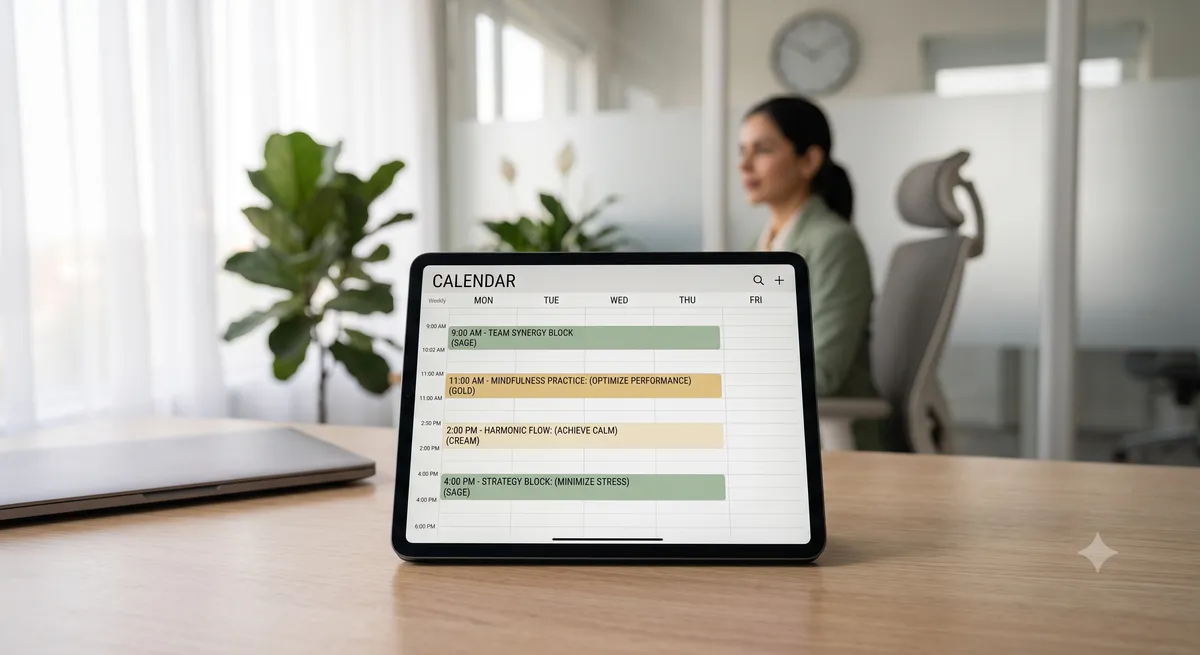
Image 2: Color-coded scheduling helps lower cognitive friction by providing clear visual cues for focus transitions.
Comparing Both Systems Side-by-Side
To choose the right approach for your workload, evaluate how timeboxing vs time blocking function across daily tasks:
Time Blocking: The Depth Builder
Time blocking is best for deep, cognitively demanding tasks that require sustained focus, such as writing code, drafting strategic plans, or analyzing data. By blocking off 2 to 3 hours for a single task and shielding yourself from interruptions, you allow your brain to enter a flow state. The focus is on the process of work, not a specific output.
Timeboxing: The Execution Accelerator
Timeboxing is ideal for administrative tasks, open-ended research, or tasks prone to perfectionism. By setting a strict 30-minute box for research or slide design, you prevent endless adjustments. The focus is on completing the task within the set constraint, forcing efficiency.
Which Framework Beats Procrastination for Your Personality?
Selecting the winning system in the timeboxing vs time blocking comparison depends on your personality type and the emotional triggers behind your procrastination:
• The Perfectionist (Winner: Timeboxing): If your procrastination is driven by a fear of making mistakes, you will benefit from timeboxing. The strict time limit forces you to accept "good enough" work, helping you start tasks without the anxiety of achieving perfection.
• The Distracted Worker (Winner: Time Blocking): If you struggle with context-switching, checking emails, or opening messages, use time blocking. Creating a dedicated 2-hour focus block builds an environment that shields you from minor interruptions. To clear digital distractions, review our 48-hour digital detox guide.
• The Overwhelmed Professional (Winner: Hybrid Stack): For high-stress days, stack both systems. Block out your morning for deep work, and use timeboxed slots in the afternoon to handle administrative tasks. Stack these time strategies with somatic exercises to keep your stress levels low. For quick resets, see our guide on micro-meditation routines.
To build a resilient daily schedule, establish clean professional limits. To protect your personal recovery time, check out our guide on remote work boundaries, and explore our review of sleep hygiene and circadian rhythms to align your sleep schedule.
Frequently Asked Questions About Time Management
Can I use timeboxing vs time blocking together in a single workday?
Yes. Many high-performing professionals use a hybrid system. They use time blocking for their primary morning projects (deep focus) and timeboxing in the afternoon to manage email, slide design, and administrative reviews.
What should I do if I fail to complete a timebox on time?
Stop working when the timebox expires. Treat the incomplete task as an objective data point, not a failure. Evaluate why it took longer than expected, adjust your future estimates, and schedule a new timebox to complete it. Do not let the task spill over and disrupt your remaining schedule.
How do these frameworks help regulate stress?
Procrastination creates a nagging anxiety known as attention residue. By scheduling your tasks into structured boxes or blocks, you clear this mental background stress, giving your prefrontal cortex clear parameters for execution.
Cited Scientific Sources & Literature
- Steel, P. (2007). The nature of procrastination: A meta-analytic and theoretical review of quintessential self-regulatory failure. Psychological Bulletin, 133(1), 65-94. [PubMed PMC]
- Covey, S. R. (1989). The 7 Habits of Highly Effective People. Simon & Schuster.
- Sapolsky, R. M. (2004). Why Zebras Don't Get Ulcers. Holt Paperbacks.