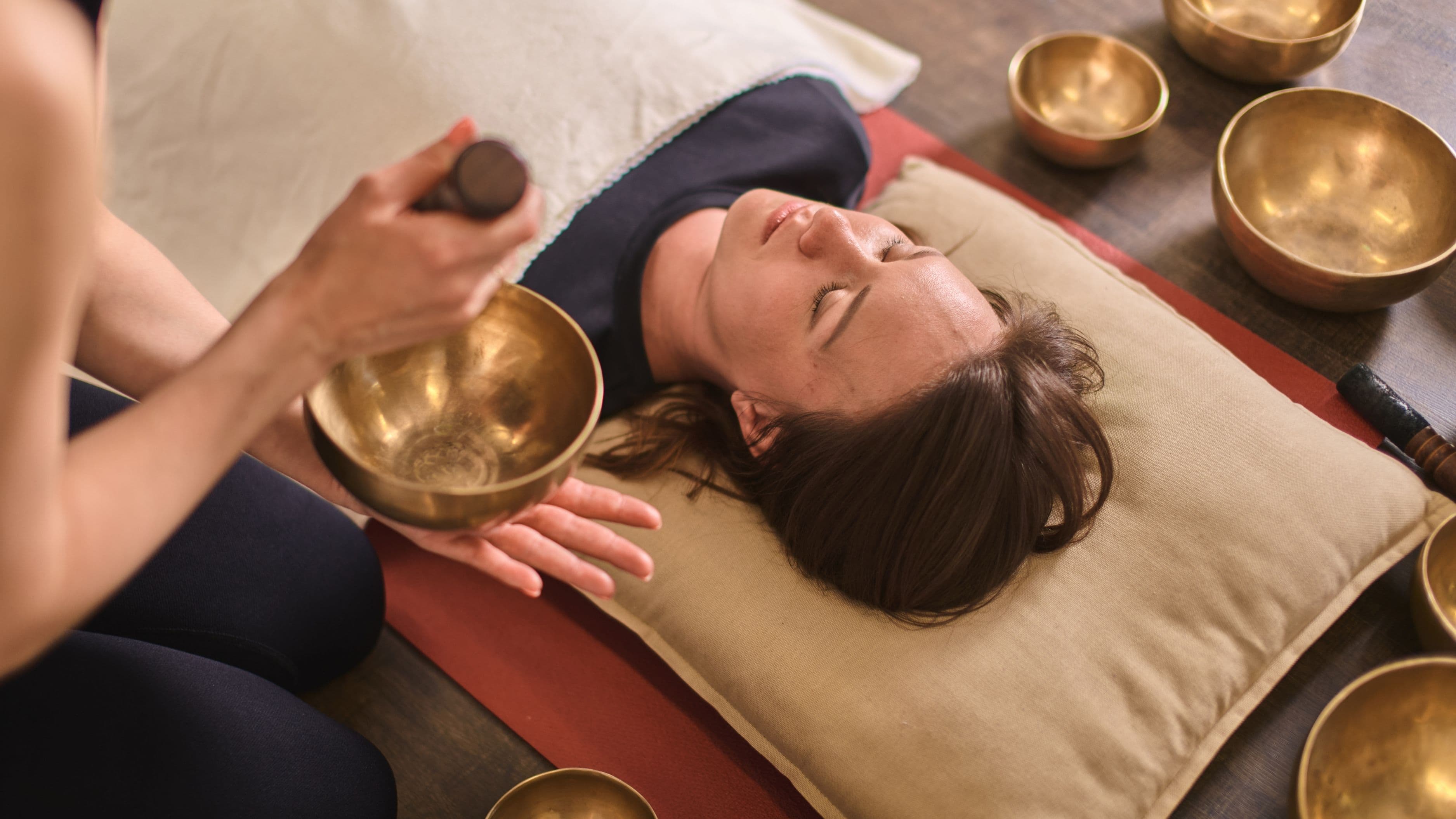
Sound healing — the use of intentional sound frequencies, instruments, and vibration to support mental, emotional, and physical wellbeing — is one of the oldest therapeutic practices on earth, found in Indigenous ceremonies, Tibetan monasteries, ancient Greek healing temples, and modern clinical settings alike. And yet most people encounter it for the first time as something to be skeptical about: a wellness trend dressed in crystal bowls and incense, more spiritual theater than substance. That skepticism is understandable. It's also worth examining — because the myths surrounding sound healing are doing real work to keep people from a practice that might genuinely change how they feel.
Let's dismantle them, one by one.
Myth 1: Sound Healing Is Just Relaxing Music
Truth: It works on your nervous system at a frequency level that ordinary music doesn't reach.
There's a meaningful difference between putting on a calming playlist and lying inside the resonance field of a Tibetan singing bowl. Both involve sound. Only one of them makes your bones vibrate. Sound healing works through a principle called resonance — the tendency of one vibrating object to cause another to vibrate at the same frequency. When a practitioner strikes a singing bowl near your body, the sound waves don't just travel to your ears; they move through your tissues, your water-dense cells, your nervous system. The experience isn't passive listening. It's closer to being tuned.
Specific sound healing instruments — including Tibetan and crystal singing bowls, gongs, tuning forks, and drums — produce frequencies that interact with brainwave states in documented ways. Research published in the Journal of Evidence-Based Integrative Medicine found that a single sound meditation using singing bowls significantly reduced tension, anger, fatigue, and depressed mood in participants, with the most marked improvements in those who had never tried it before. That's not the effect of pretty background noise — that's neurological intervention through vibration.
The distinction matters because it changes how you approach the practice. You're not there to enjoy the sounds the way you'd enjoy a song. You're there to let them work on you, the way you'd let a massage work on tight muscles — by releasing control, softening resistance, and allowing the frequency to do what frequency does.
Myth 2: You Have to Believe in It for It to Work
Truth: Your skepticism is welcome — your nervous system doesn't share it.
This is the myth that keeps the most analytically minded, most science-oriented people from ever giving sound healing a real chance. The assumption is that it operates like a placebo — effective only for people who've already bought in, whose belief does the actual therapeutic work. It's a reasonable concern. And it misunderstands how vibroacoustic therapy functions.
Sound waves are physical phenomena. They do not require belief to move through matter. When low-frequency sound causes your heart rate to slow, your breathing to deepen, and your muscle tension to release, those are measurable physiological events occurring regardless of what your conscious mind thinks about singing bowls. A 2016 study in the Journal of the Acoustical Society of America found that exposure to specific low-frequency tones produced measurable reductions in cortisol — the body's primary stress hormone — in participants who were explicitly skeptical about the practice going in. The body, it turns out, is less opinionated than the mind.
What belief does support is your willingness to stay present long enough for the practice to reach you — to not spend the entire session in your head composing a critique. That's not faith in the mystical. That's just basic openness, the same openness that makes any new experience worth having.
Myth 3: It's a New Age Trend With No Real History
Truth: Sound as medicine predates written history — and modern science is catching up to ancient knowledge.
The impulse to dismiss sound healing as a recent wellness invention says more about cultural blind spots than about the practice itself. Indigenous cultures across every inhabited continent have used rhythmic drumming, chanting, and resonant instruments in healing ceremonies for tens of thousands of years. Ancient Greek physicians used music in their healing temples. Tibetan monks have used singing bowls in contemplative and therapeutic practice for over a thousand years. The Aboriginal peoples of Australia used the didgeridoo — now known to produce frequencies in the 70–80 Hz range that align with the brain's delta and theta waves — as a healing instrument long before neuroscience had words for what was happening.
Modern research hasn't invented sound healing. It's arrived, somewhat belatedly, at an explanation for why it works. Neuroscientists studying binaural beats — a sound healing technique in which slightly different frequencies are played in each ear, causing the brain to process a third, internal frequency — have found measurable changes in brainwave activity, pain perception, anxiety levels, and sleep quality. The National Institutes of Health has funded research into music therapy and vibroacoustic healing, and hospitals including the Cleveland Clinic and Johns Hopkins have integrated sound-based therapies into pain management and mental health care protocols.
This isn't fringe. This is centuries of embodied wisdom being confirmed by instruments sensitive enough to finally measure what healers already knew.
Myth 4: It's Only for Spiritual People
Truth: Sound healing is a somatic practice — and your body qualifies, whatever your beliefs.
The imagery surrounding sound healing — crystal bowls, candlelit studios, practitioners in flowing white linen — can make it feel like membership requires a certain kind of spiritual identity. It doesn't. Sound healing is, at its foundation, a body-based practice. It works through the physical architecture of the human nervous system, not through any particular belief system. You can be a complete agnostic about chakras and still experience a measurable drop in anxiety after a 45-minute gong bath. The body doesn't ask for your spiritual credentials before it relaxes.
That said, many people do find that sound healing opens unexpected interior doors — a quality of stillness that feels different from ordinary quiet, an emotional release that arrives without warning from somewhere deep and wordless, a sense of connection to something larger that's hard to name and impossible to dismiss. These experiences don't require a metaphysical framework to be real and valuable. They're simply what happens when the nervous system genuinely lets go — something most of us experience so rarely that it arrives as a revelation the first time it does.
Whether you come to sound healing as a science-curious skeptic or a spiritually open seeker, the practice meets you where you are. The vibrations don't discriminate. The only requirement is showing up and getting quiet enough to receive what's already there.
Myth 5: One Session Won't Make a Difference
Truth: A single session can shift your baseline — and regular practice compounds the effect.
There's a pervasive idea in wellness culture that real change requires sustained effort over long periods — that anything offering relief in a single session must be superficial. Sound healing challenges this assumption in interesting ways. While consistent practice absolutely deepens the benefits, the research on single-session effects is genuinely compelling. Studies measuring anxiety, mood, and physiological stress markers before and after one sound bath consistently show significant improvement, even in first-time participants. The shift isn't subtle. People describe leaving a session feeling lighter, softer, more spacious inside — like something that had been clenched for months quietly opened.
This matters because it lowers the barrier to beginning. You don't need to commit to a practice or build a collection of instruments or become a devotee to benefit. You need one afternoon, one session, one willingness to let sound do something to you that you can't fully explain. The calm that washes over you in the final minutes of a well-facilitated sound bath — that warm, heavy, deeply restful feeling, like being wrapped in something both vast and very close — is not manufactured. Your nervous system produced it. Sound invited it.
What regular practice adds is not the depth of individual experiences, but their frequency and accessibility. Over time, practitioners report that the states induced during sound healing become easier to access in daily life — that the regulated, open, present feeling starts to bleed into ordinary moments, creating a new resting baseline for the nervous system. That's not a small thing. For people managing chronic stress, anxiety, or the cumulative weight of modern life, a shifted baseline is everything.
Myth 6: You Need an Expensive Practitioner or Studio
Truth: Sound healing starts with what you already have access to — including your own voice.
The image of sound healing as an expensive studio experience — a $45 group session, a private practitioner, a set of crystal bowls that cost more than your monthly groceries — obscures a more democratizing truth: the most fundamental sound healing instrument in existence is the human voice. Humming. Toning. Chanting. Singing softly to yourself in a quiet room. These practices stimulate the vagus nerve directly, activating the parasympathetic nervous system — the "rest and digest" state that is the physiological opposite of chronic stress — in ways that are free, immediate, and available at any moment.
The vagus nerve, which runs from your brainstem through your heart and gut, is particularly responsive to vocal vibration. When you hum with your mouth closed, the vibration travels internally, resonating through your sinuses, your chest cavity, your throat. Research on humming meditation shows reductions in heart rate and blood pressure comparable to more structured relaxation techniques — and it requires nothing but a few minutes and a willingness to make sound. Starting there — with your own voice, in your own living room — is a completely legitimate entry point into sound healing practice.
From there, accessible tools exist at every price point: free binaural beat recordings on YouTube and Spotify, $15 tuning forks on Amazon, community sound bath events offered at yoga studios and wellness centers at low or sliding-scale cost. Sound healing does not require expensive access. It requires only the decision to use sound with intention — to let it be something you give to your nervous system rather than just something that happens in the background.
Myth 7: It's a Substitute for Real Mental Health Support
Truth: Sound healing is a complement, not a replacement — and that's exactly what makes it powerful.
This myth operates in both directions. Some practitioners overstate the therapeutic claims of sound healing in ways that position it as a standalone treatment for serious mental health conditions. Some mental health professionals dismiss it entirely as outside the bounds of evidence-based care. Both positions miss a more nuanced and genuinely useful truth: sound healing is a somatic support tool that works beautifully alongside conventional mental health practices, not instead of them.
For someone in therapy, regular sound healing practice can deepen the somatic dimension of emotional processing — helping the body release what the mind is working to understand. For someone managing anxiety, a daily humming practice or binaural beat session can regulate the nervous system between therapy appointments, building physiological resilience in the stretches of ordinary life that therapy doesn't reach. For someone simply feeling the weight of modern existence — disconnected, depleted, running on cortisol and caffeine — sound healing offers a way back into the body that is immediate, accessible, and genuinely nourishing.
What sound healing cannot do is replace professional support for serious mental illness, trauma, or crisis. If you are struggling, please reach out to a qualified mental health professional. What sound healing can do is make the space between those appointments feel less barren and more supported — and sometimes, that is precisely what gets someone through.
The Sound That Was Always There
Here's what no one fully prepares you for the first time you experience real sound healing: the silence it reveals. Not the silence of absence, but the silence of depth — a quality of inner quiet that feels alive rather than empty, spacious rather than hollow. That silence has always been there, underneath the noise of obligations and worries and the relentless scroll of modern life. Sound healing doesn't create it. It clears enough away for you to finally hear it.
Let go of the idea that healing must be hard to be real. Let go of the skepticism that keeps you standing outside experiences your body is already curious about. Let go of the belief that ancient wisdom needs a clinical study to earn your trust — and start making room for the practices that have been working on human nervous systems for longer than modern medicine has existed.
The bowl is ringing. The frequency is already moving through you. All that's left is to listen.
Let go of outdated ideas about what healing looks and sounds like — and start making moves that actually work.
📚 Sources
1. Goldsby, T. L., Goldsby, M. E., McWalters, M., & Mills, P. J. (2017). Effects of singing bowl sound meditation on mood, tension, and well-being: An observational study. Journal of Evidence-Based Integrative Medicine, 22(3), 401–406. https://doi.org/10.1177/2156587216668109
2. Wahbeh, H., Calabrese, C., & Zwickey, H. (2007). Binaural beat technology in humans: A pilot study to assess psychologic and physiologic effects. Journal of Alternative and Complementary Medicine, 13(1), 25–32. https://doi.org/10.1089/acm.2006.6196
3. Porges, S. W. (2011). The Polyvagal Theory: Neurophysiological Foundations of Emotions, Attachment, Communication, and Self-Regulation. W. W. Norton & Company.
4. National Center for Complementary and Integrative Health. (2023). Music and Health: What You Need To Know. NCCIH.nih.gov. https://www.nccih.nih.gov/health/music-and-health-what-you-need-to-know
5. Heckroth, M., Lucatorto, M. A., & Reitt, M. (2021). Vibroacoustic therapy: An evidence-based, integrative approach to pain and anxiety management. Critical Care Nursing Quarterly, 44(1), 73–81. https://doi.org/10.1097/CNQ.0000000000000340