These aren't those.
The ten upgrades below were chosen because they solve something real - a room that never feels quite right, a sleep that's never quite deep enough, a morning that always starts a little too harshly. Each one is practical, backed by research, and designed to support the kind of home that quietly works for you rather than adding more to manage.
You don't need to do all ten. Start with the one that speaks most directly to something you're already feeling.
1. A Smart Thermostat That Learns Your Rhythm
Most people don't think about temperature until they're uncomfortable - too warm to focus, too cold to relax, too stuffy to sleep. A smart thermostat removes that friction by learning when you're home, when you're sleeping, and what temperatures actually work for your body.
In real life: You wake up to a bedroom that's already at the right temperature. You come home from work to a space that's been warming up for the last twenty minutes. You stop touching the dial entirely.
Research published in Building and Environment found that thermal comfort is one of the strongest predictors of perceived well-being in residential spaces. Getting it right - consistently, automatically - matters more than most people expect.
Beyond comfort, the efficiency gains are real. The EPA estimates smart thermostats can save around 8% on heating and cooling costs annually, which adds up across a year without any effort on your part.
Worth knowing: Look for models that allow room-by-room scheduling if different people in your home have different preferences. Compatibility with your existing heating and cooling system matters too - check before you buy.
2. Warm-Toned Smart Bulbs for Evening Wind-Down
The light in your home after sunset has a direct effect on how quickly your brain shifts into rest mode - and most standard overhead lighting actively works against that process.
Cool, bright light signals daytime to your brain's circadian system. Warm, dim light does the opposite. Smart bulbs that shift from cool white during the day to amber in the evening give your nervous system the cues it needs to wind down naturally.
In real life: By 8pm, your living room feels noticeably softer. You stop feeling wired at bedtime without quite knowing why. You start falling asleep faster.
A widely cited study in the Journal of Clinical Endocrinology and Metabolism found that exposure to electric light before sleep suppresses melatonin - with cool-toned light having the most significant effect. Switching to warm tones in the hours before bed is one of the simplest, most evidence-backed changes you can make.
Worth knowing: You don't need to replace every bulb at once. Start with the rooms you use most in the evening - bedroom and living room first.
3. A White Noise Machine (or Smart Speaker Set to Do the Same)
Noise is one of the most underestimated sources of home-based stress. Traffic outside, a partner's different sleep schedule, a building that carries sound further than it should - these things chip away at rest and focus in ways that are easy to dismiss but hard to ignore once you start paying attention.
A white noise machine - or a smart speaker running a consistent ambient sound - creates an acoustic buffer that helps your brain stop scanning for input and finally settle.
In real life: You sleep through the neighbor's early alarm. You focus during work from home without the distraction of ambient noise pulling at your attention. Your bedroom becomes quieter without the building actually changing.
Research from the Journal of Caring Sciences found that white noise significantly improved sleep quality in ICU patients - a population where sleep disruption is extreme. The same principle, in milder form, applies at home.
Worth knowing: Pink noise (slightly softer than white noise) and brown noise (deeper, more rumbling) work better for some people. Many smart speakers have all three available - it's worth experimenting.
4. A Smart Air Purifier With Real-Time Monitoring
Indoor air quality is something most people never think about - which is exactly why it tends to affect them without their realizing it. Dust, VOCs from furniture and cleaning products, pet dander, and outdoor pollution that drifts in all contribute to an environment that can affect sleep, focus, mood, and respiratory health.
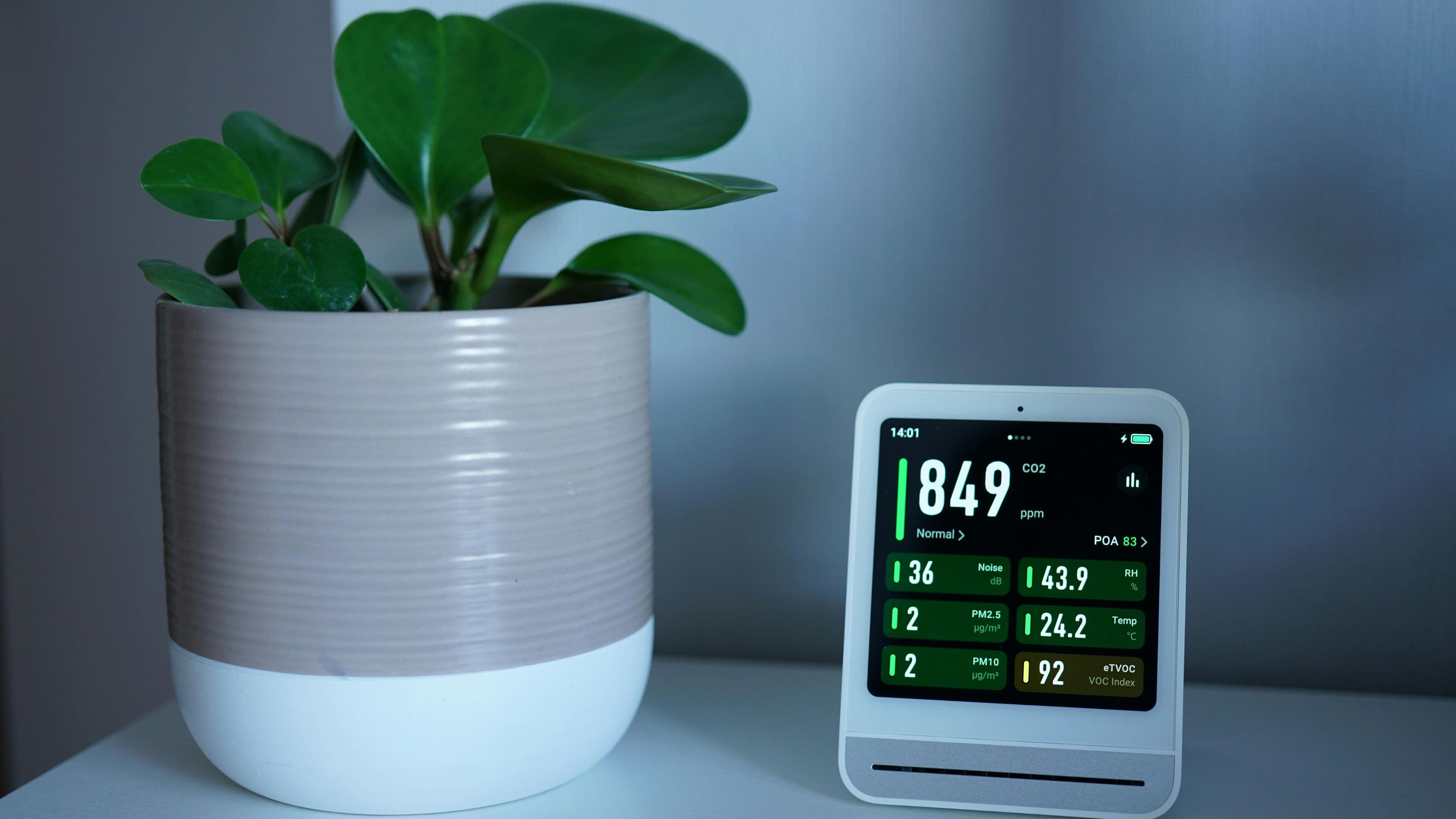
A smart air purifier with real-time monitoring shows you what's actually in your air and works automatically to address it. Some models integrate with other smart home devices to adjust when air quality drops.
In real life: You notice you sleep better with it running. You stop waking up with a dry throat. On high-pollution days, your home stays a noticeably calmer place to breathe.
The EPA notes that indoor air can be two to five times more polluted than outdoor air. For a space where most people spend the majority of their time, that's worth taking seriously.
Worth knowing: HEPA filtration is the standard to look for. Avoid purifiers that use ionizers as their primary technology - some produce ozone as a byproduct, which is a respiratory irritant.
5. Blackout Blinds or Smart Shades
Light is the most powerful regulator of the human sleep-wake cycle. Even small amounts of ambient light during sleep - a streetlight through thin curtains, a neighbor's security lamp - can suppress melatonin and reduce sleep depth, even if you don't consciously wake up.
Blackout blinds solve this cleanly. Smart shades go further: they can open gradually in the morning to simulate sunrise, lifting you out of sleep more gently than any alarm.
In real life: You wake up feeling more rested without changing anything else. Your bedroom becomes a genuinely dark room for the first time, and the difference is immediate.
A 2019 study in Current Biology found that even moderate light exposure during sleep affected metabolic function and insulin sensitivity the following morning. Sleep quality is rarely just about how long you sleep - light matters.
Worth knowing: If smart shades feel like too large an investment right now, blackout curtain liners are an inexpensive starting point that makes a real difference.
6. A Smart Doorbell or Camera System for Reduced Anxiety
This one isn't often framed as a wellness upgrade - but it belongs here.
For many people, ambient low-level anxiety about home security is a quiet, constant presence. It's not dramatic. It's the part of your brain that notices an unexpected sound at night, wonders who rang the bell when you weren't expecting anyone, or doesn't quite relax when you're away.
A smart doorbell with camera and remote viewing addresses that directly. You can see who's at the door without approaching it. You can check in on your home when you're traveling. The uncertainty - which is where anxiety lives - shrinks.
In real life: You feel calmer at home after dark. You leave for trips without that nagging sense of not knowing. Small interruptions - a delivery, a knock - stop requiring a full internal alert response.
Worth knowing: Privacy considerations matter with camera systems. Choose brands with strong encryption and clear data policies, and be transparent with anyone in your household about what's being recorded and where it's stored.
7. A Smart Plug Setup for Evening Wind-Down Automation
The friction of a wind-down routine is usually what stops people from having one. You mean to dim the lights, turn off the screen, switch on the diffuser - and then you don't, because it requires doing five separate things when you're already tired.
Smart plugs let you automate the whole sequence. One voice command, one tap, or a scheduled routine can turn off the TV, switch on the lamp, start the diffuser, and signal to your body that the day is ending.
In real life: Your evenings get softer without requiring more willpower. The routine runs itself. You stop falling asleep on the sofa with the overhead light on and the television going.
Behavioral research consistently shows that environmental cues are more reliable than intention when it comes to habit formation. Building the cue into your home removes the need to decide.
Worth knowing: Smart plugs are one of the most affordable smart home entry points - and you can start with just one, on one device, to see how the automation feels before expanding.
8. A Smart Sleep Tracker or Mattress Sensor
Improving sleep is genuinely difficult when you don't know what's actually happening during it. A sleep tracker - whether worn or placed under the mattress - gives you data: how long each sleep stage lasts, when you're restless, how your environment affects your rest over time.
That information lets you make changes that are specific to your sleep, not generic advice.
In real life: You notice that your deepest sleep happens on nights when the room is cooler. You realize the second coffee of the day is affecting your sleep more than you thought. Small insights create real change.
The American Academy of Sleep Medicine recognizes consumer sleep technology as a meaningful tool for awareness and behavior change, particularly when combined with good sleep hygiene practices.
Worth knowing: No tracker is perfectly accurate, and sleep tracking can become counterproductive if you develop anxiety about your scores. Use the data as a general guide, not a verdict on how rested you are.
9. Voice-Controlled Lighting Scenes for Different Moods
Beyond simple on/off control, smart lighting systems can hold different "scenes" - preset combinations of brightness and color temperature for different moments in your day. A focus scene for working. A calm scene for winding down. A morning scene that eases you in gently.
The difference between these settings might seem subtle on paper. In practice, the right lighting for an activity noticeably affects how settled and productive you feel during it.
In real life: You stop working under the same harsh overhead light you use for everything else. Your home stops feeling like it has only one mode. Different times of day start to feel genuinely different.
Research on architectural lighting design consistently shows that lighting variability - having different intensities and color temperatures available - is linked to higher satisfaction in residential environments.
Worth knowing: You don't need an elaborate system. Even a single smart bulb in a key lamp, with two or three saved scenes, can shift how a room feels across the day.
10. A Smart Humidifier for Dry Indoor Air
Particularly in heated homes during winter, or in climates where air conditioning runs constantly, indoor humidity drops well below the range that's comfortable for the body. Dry air affects sleep, skin, respiratory comfort, and even the quality of houseplants that contribute to a calming environment.
A smart humidifier monitors humidity levels and adjusts automatically - running when levels drop too low, switching off when they're restored. You set the target once and forget it.
In real life: You stop waking up with a dry throat. Your skin holds moisture better through colder months. The air in your bedroom feels noticeably more comfortable to breathe, which makes rest easier.
The American Society of Heating, Refrigerating and Air-Conditioning Engineers (ASHRAE) recommends indoor relative humidity between 30-60% for comfort and health. Most dry indoor environments fall well below that range without occupants realizing it.
Worth knowing: Keep the unit clean. Humidifiers can harbor mold and bacteria if water sits in the tank for too long - most smart models remind you when cleaning is due, which helps.
A Reflection Before You Start
The goal of a smart home isn't to add more technology to manage. It's to reduce the small daily frictions that cost you more energy than you realize - and to create a space that supports your rest, focus, and ease without requiring constant decisions from you.
Start with one upgrade. The one that solves something you're already feeling. Let it settle, notice what changes, and let that guide what comes next.
Progress here isn't about having the most connected home. It's about having a home that feels, quietly and consistently, like it's working for you.
FAQ
Do smart home upgrades require technical knowledge to set up? Most modern smart home devices are designed for straightforward setup - usually involving a smartphone app and a home Wi-Fi connection. That said, some systems are simpler than others. Starting with standalone devices (a smart bulb, a white noise machine, a smart plug) rather than integrated ecosystems keeps things manageable.
Are smart home devices secure? Security varies by brand and product. Look for devices that offer regular firmware updates, two-factor authentication, and clear privacy policies. Reputable brands take security seriously - it's worth spending a few minutes researching before purchasing.
What's the best first upgrade for someone just starting out? Smart bulbs or a white noise machine are both low-cost, easy to implement, and produce noticeable results quickly. Either makes a good first step because the feedback is immediate and the investment is modest.
Can these upgrades actually reduce stress, or is that overstated? The honest answer is: they support the conditions for less stress. Better sleep, cleaner air, softer evenings, and a more predictable environment all reduce the low-level load your nervous system carries. They're not a substitute for addressing the sources of stress in your life - but they make a real difference to your baseline.