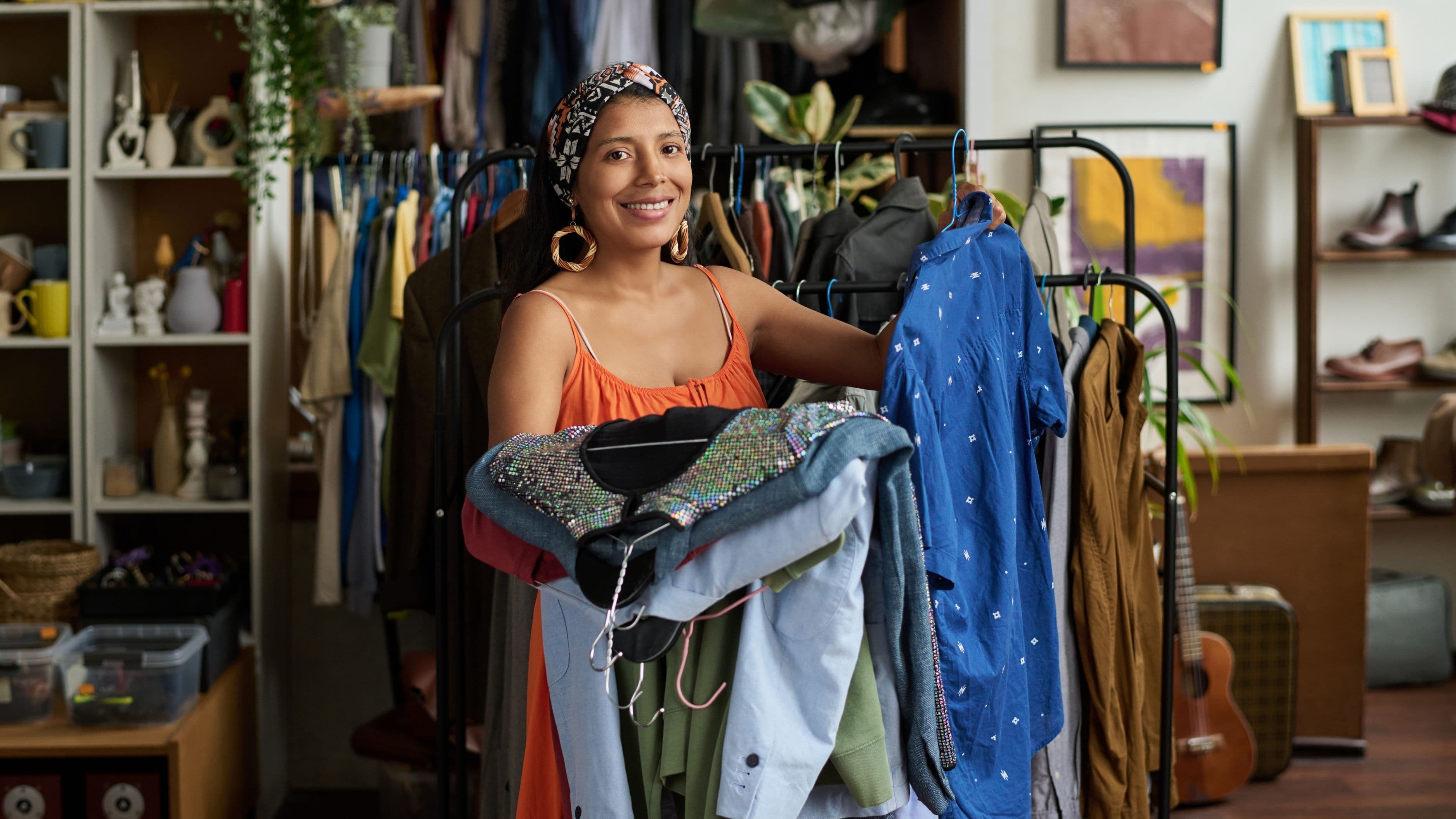
I was standing in a thrift store on a gray Tuesday afternoon, not looking for anything in particular — just killing twenty minutes before a dentist appointment down the street. And there it was: a small ceramic table lamp with a hand-painted base, the kind of dusty turquoise that looks like the ocean just before a storm. It was $4. I didn't need a lamp. My apartment had perfectly functional lighting. But something about holding that lamp — the weight of it, the imperfect glaze, the faint mystery of who owned it before — made me feel unexpectedly grounded. Like I'd picked up a small piece of someone else's story and it fit surprisingly well in my hands.
I bought it. I still have it. And somewhere in that small, unhurried exchange, something shifted in how I thought about the things I bring into my life and why.
Secondhand shopping — the practice of buying pre-owned clothing, furniture, books, and household items through thrift stores, consignment shops, online marketplaces, and estate sales — has moved far beyond budget necessity. For people craving intentionality, sustainability, and a quieter relationship with consumption, it's become a practice as meaningful as any other conscious living choice. Here's what I've learned, and what that lamp taught me about slowing down and choosing differently.
1. Slowing Down Is the Whole Point
Fast culture has a checkout button — thrifting doesn't
Secondhand shopping is, by nature, unhurried. There is no algorithm curating your preferences, no "frequently bought together" nudge, no one-click purchase that arrives at your door before you've had time to wonder if you actually wanted it. You have to show up, look through racks and shelves with your own hands, and make decisions in real time without the manufactured urgency of a countdown timer. That friction — which modern retail has worked tirelessly to eliminate — turns out to be quietly sacred.
There's something almost meditative about moving slowly through a thrift store, the faint smell of cedar and old paperbacks in the air, the soft clatter of hangers. You're not chasing; you're discovering. The practice naturally deactivates the reactive, impulse-driven part of your brain and engages something more deliberate — a kind of tactile mindfulness that's hard to replicate online.
Mindfulness researchers note that engaging the senses in low-stimulation environments can reduce cortisol levels and create a genuine sense of present-moment awareness. Thrifting, it turns out, is cheaper than a meditation app and comes with the possibility of finding a vintage denim jacket.
The slowness also creates space for honest self-reflection. When you can't filter by size and color and have it appear in 24 hours, you start to ask different questions: Do I actually love this, or do I just love the idea of it? Does this serve the life I'm living, or the life I'm performing? Those are not small questions. They're the ones that change how you live.
2. Everything Carries a Story — And That's a Gift
Objects hold energy; choosing them mindfully matters
One of the most interesting things about secondhand items is that they arrive with a past. A worn paperback with someone's underlining in the margins. A quilt whose stitching speaks of hours and care. A set of dishes that fed another family's Sunday mornings before finding their way to yours. For people drawn to depth and meaning, this isn't creepy — it's connective. It's a physical reminder that we are not the first, and that the things we steward matter beyond our own moment.
Many spiritual traditions speak of objects absorbing the energy of the spaces and people they inhabit — a concept sometimes called object memory or psychometry in metaphysical contexts, but reflected more practically in the simple human truth that certain items feel different from others. A mass-produced shelf piece from a big-box store and a hand-thrown ceramic bowl from an estate sale occupy the same physical space in your home, but they don't feel the same. One was manufactured for a transaction. The other was made, used, loved, and passed on. Surrounding yourself with the latter is a form of intentional curation — choosing depth over disposability.
This awareness naturally extends to how you relate to your own possessions. When you begin to sense that objects carry histories, you start treating yours with more care — giving things away thoughtfully, choosing purchases slowly, and building a home environment that feels genuinely inhabited rather than merely decorated.
3. Conscious Spending Is a Spiritual Practice
Where your money goes is where your values live
There is a version of conscious living that stays entirely interior — meditation cushions, journaling, breathwork — and there is a version that extends outward into the everyday choices of how we spend, consume, and move through the material world. Secondhand shopping sits firmly in that second category. Every thrift store purchase is a quiet act of values alignment: choosing to extend the life of an object instead of funding the production of a new one, choosing sufficiency over accumulation, choosing meaning over marketing.
The fast fashion industry alone produces 92 million tons of textile waste annually, according to the Ellen MacArthur Foundation — a number so large it becomes abstract until you're standing in front of a rack of gently worn clothes that would otherwise be heading to landfill. Buying secondhand doesn't require a manifesto or a perfectly zero-waste lifestyle. It just requires a small, consistent willingness to pause before buying new and ask whether the secondhand option might serve just as well — or better. That pause, repeated over time, reshapes the relationship between who you are and what you own.
Money spent at a local thrift store or consignment shop also often stays closer to home — funding non-profit organizations, small business owners, and community programs rather than quarterly earnings reports for global corporations. For people who want their daily choices to reflect their deepest values, that distinction carries weight.
4. Less Really Does Feel Like More
The clutter clarity no one tells you about
There's a specific kind of lightness that comes from owning fewer things — and owning better-chosen things. It isn't the sterile, performative minimalism that gets photographed for Pinterest boards. It's more organic than that: a sense of ease when you walk into a room, a quiet satisfaction when everything you own has a reason to be there. Secondhand shopping, practiced with intention, naturally produces this feeling because the discovery-based nature of thrifting means you only bring something home when it genuinely speaks to you — not because it was on sale or showed up in your feed at a vulnerable moment.
Research on material goods and wellbeing consistently shows that beyond a baseline level of comfort, accumulating more possessions does not increase happiness and can actively increase stress. Clutter has been linked to elevated cortisol levels, reduced focus, and a pervasive low-grade sense of overwhelm — the kind that's hard to name but impossible to ignore.
Secondhand shopping, paradoxically, can become a tool for owning less rather than more, because the effort involved naturally filters out casual, unconsidered purchases. You buy the $4 lamp because you felt something real holding it. You put back the seventeen other things you touched.
This shift from accumulation to curation is one of the most quietly transformative aspects of the practice. Your home begins to feel like a reflection of who you actually are — not who you were when you clicked "add to cart" at midnight.
5. Thrifting Builds a Muscle Called Enough
Learning to recognize satisfaction before seeking more
Modern consumer culture is architecturally designed to ensure you never quite feel satisfied — there is always a newer version, a better model, an upgrade waiting to make your current possession feel slightly inadequate. Secondhand shopping disrupts this loop in a way that feels almost rebellious. When your turquoise lamp already exists in the world, fully formed and waiting, the idea of buying a brand-new version of it starts to feel not just unnecessary but somehow beside the point.
Over time, regular thrift shoppers report a measurable shift in how they experience desire itself. The urgency softens. The craving for newness becomes less reflexive. This is the muscle of enough — the capacity to feel genuinely satisfied with what is, rather than perpetually restless for what isn't. For anyone on a path of intentional living or spiritual growth, that capacity is foundational. You can't feel truly present in a life you're always trying to upgrade.
Psychologist Barry Schwartz, in his influential work The Paradox of Choice, argues that an overabundance of options creates not freedom but anxiety — the persistent feeling that you might be making the wrong choice, that something better is always just out of reach. Secondhand shopping, with its limited and unpredictable inventory, eliminates the tyranny of endless options. You find what's there. You choose or you don't. The decision feels clean.
6. Community Lives in the Places Between the Racks
Thrift stores are some of the last unhurried third spaces
There is something quietly countercultural about a place where time moves differently — where you might have an unexpected conversation with a stranger about a vintage record, where the person behind the counter knows the regulars by name, where nobody is trying to upsell you or capture your data. Thrift stores, estate sales, and community swaps are some of the last genuinely unhurried third spaces in modern life, and for people craving authentic connection, that matters more than it might seem.
The sociologist Ray Oldenburg coined the term "third place" to describe community spaces that exist outside the home (first place) and work (second place) — coffee shops, barbershops, public parks, and yes, the kind of neighborhood thrift store where browsing is its own reward. These spaces are declining as commerce moves online and public life becomes increasingly transactional. Walking into a thrift store is, in a small but real way, an act of participation in physical community — choosing presence over convenience, human contact over algorithmic curation.
For people on a path of conscious living, this dimension of secondhand shopping often goes unmentioned but lands deeply. The things we find matter. The spaces we inhabit to find them matter too.
7. Beauty Doesn't Have to Cost the Earth
Abundance and sustainability are not opposites
One of the most liberating discoveries of secondhand shopping is the sheer, unexpected quality of what exists in the world already. Hand-knotted rugs at thrift store prices. Solid wood furniture that will outlast anything assembled from a flat-pack box. Silk blouses, leather boots, vintage linen — things made in an era when durability was considered a feature rather than a liability. The abundance is real, and it has a texture to it: worn in, broken down to softness, beautiful in the way that only time produces.
The environmental case for secondhand is significant. According to ThredUp's 2023 Resale Report, buying one secondhand item instead of new saves an average of 1.4 pounds of CO2. Scaled across a household — clothing, furniture, books, kitchen goods — the cumulative impact is substantial, and it carries none of the sacrifice that "sustainable living" is often assumed to require. This is not deprivation in service of principle. It's abundance in better alignment with your values.
Wearing or living with beautiful things you found, chose, and carried home yourself also creates a relationship with those objects that off-the-shelf purchasing simply cannot replicate. That relationship — personal, tactile, storied — is its own form of richness.
The Lamp Is Still On
That $4 lamp sits on my nightstand now, casting a warm amber circle across the wall each evening. It reminds me, in its quiet ceramic way, that slowing down is not falling behind. That choosing what already exists is its own form of creativity. That the things worth having rarely announce themselves — they wait to be found by someone who is actually paying attention.
Secondhand shopping won't solve everything. It won't quiet your mind on a hard day or mend a fraying relationship or answer the deep questions you're carrying. But it can be one more way of practicing what most of us are quietly working toward: a life that feels chosen rather than defaulted into, curated rather than cluttered, and rich in the specific way that has nothing to do with newness.
Pick up the lamp. Feel its weight. Ask if it belongs in your story. That question — asked slowly, honestly, again and again — has a way of changing more than just what's on your shelves.
📚 Sources
1. Ellen MacArthur Foundation. (2017). A New Textiles Economy: Redesigning Fashion's Future. ellenmacarthurfoundation.org. https://ellenmacarthurfoundation.org/a-new-textiles-economy
2. ThredUp. (2023). 2023 Resale Report. ThredUp.com. https://www.thredup.com/resale/
3. Schwartz, B. (2004). The Paradox of Choice: Why More Is Less. HarperCollins.
4. Oldenburg, R. (1989). The Great Good Place: Cafes, Coffee Shops, Bookstores, Bars, Hair Salons, and Other Hangouts at the Heart of a Community. Paragon House.
5. Roster, C. A., Ferrari, J. R., & Jurkat, M. P. (2016). The dark side of home: Assessing possession 'clutter' on subjective well-being. Journal of Environmental Psychology, 46, 32–41. https://doi.org/10.1016/j.jenvp.2016.03.003