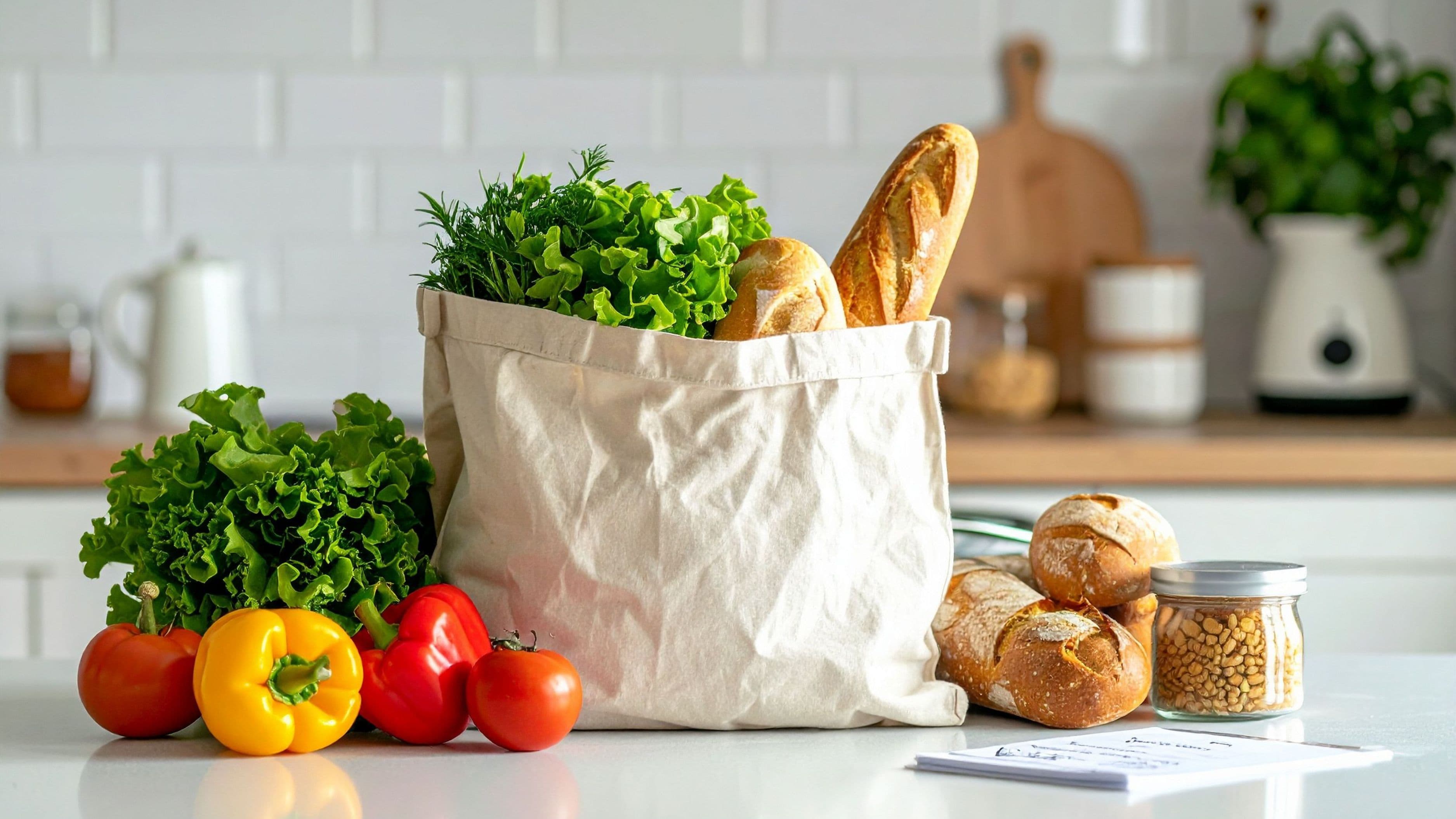
If Marie Kondo decluttered your shopping habits, she'd stand in your kitchen, hold up that half-empty jar of tahini you bought in February with great intentions, and ask in the most serene voice imaginable: "Does this spark joy — or just guilt?" She'd then move quietly to your pantry, where three open boxes of the same pasta live in uneasy coexistence, and suggest — gently, lovingly — that maybe the chaos didn't start at the grocery store. It started before you ever left the house.
Here's the thing nobody tells you about grocery shopping: it is one of the most mindless rituals in modern life masquerading as a productive one. You go in for milk. You come out $87 lighter with a scented candle, two kinds of chips, and a sourdough starter kit you will absolutely never use. According to the USDA, the average American household throws away between 30 and 40 percent of its food supply — that's roughly $1,500 a year, per family, composting itself quietly in the back of the fridge. And yet we keep shopping the same way, week after week, in a trance of habit and hunger.
A monthly shopping list — a real one, built with intention and a little bit of self-knowledge — changes all of that. Not because it's a magic spreadsheet, but because it forces you to pause, pay attention, and make decisions from a place of clarity rather than a place of "I think we might be out of cumin?" This isn't just practical advice. At Harmony Hub, we believe that the way you show up to the mundane things — yes, including grocery shopping — is the way you show up to your life. So let's build something that actually works.
1. The Pantry Séance 👻
Meet your food before you buy more of it.
Before you write a single item on your list, you need to have an honest conversation with your existing pantry. Open every cabinet. Pull things forward. Look at what's actually in there — not what you assume is in there, not what you wish was in there, but what is physically present in your kitchen right now. This is the step most people skip, and it's the reason they come home from Costco to discover they already own four bottles of soy sauce.
Think of it as a household audit with spiritual undertones. You are making visible what has been invisible. That can of chickpeas hiding behind the balsamic vinegar? It has been waiting patiently for months. Give it a purpose. The freezer situation deserves its own moment of reckoning — pull things out, check dates, make a mental note of what needs to be used in the coming weeks so it can actually shape what you buy rather than compete with it.
This step alone can save you $30–$50 on a typical monthly shop, just by eliminating duplicate purchases and integrating forgotten ingredients into your actual meal plan. It also delivers something harder to quantify: the quiet satisfaction of knowing exactly what you have. That feeling of clarity — of your home being legible to you — is grounding in a way that ripples outward into the rest of your day.
2. The Meal Blueprint (Not a Meal Plan) 🗺️
Loose structure beats rigid perfection every time.
The phrase "meal plan" makes a lot of people break out in a mild existential sweat. It conjures images of color-coded spreadsheets, Sunday batch cooking marathons, and the crushing guilt of Thursday's "planned" lemon herb salmon sitting uneaten while you ordered Thai food at 8pm. Let go of that version. What you actually need is a meal blueprint — a loose, flexible framework that gives your shopping list direction without locking you into a contract you'll resent by Wednesday.
Here's how it works: instead of assigning specific meals to specific days, decide on the types of meals you'll cook this month. For example — four pasta nights, three stir-fry nights, two soup batches, a handful of grain bowls, and let's say six "fend for yourself" evenings where leftovers and eggs do the heavy lifting. From that loose sketch, you can reverse-engineer a shopping list that covers the ingredients without over-specifying. You buy a protein, a starch, a rotating cast of vegetables, and the pantry staples that make all of it taste intentional.
This approach honors the reality of modern life: your energy levels change, plans shift, and eating is an emotional experience, not a logistical one. A blueprint says this is the general direction — and that's enough. Research published in the Journal of the Academy of Nutrition and Dietetics found that households that engaged in even minimal meal planning purchased more nutritious foods and spent significantly less compared to those who shopped without any prior planning. You don't have to plan perfectly. You just have to plan a little.
3. The Category Sorting Hat 🎩
Stop shopping like a stream of consciousness.
If your current shopping list looks like a literary monologue — olive oil, also we need toilet paper, oh and that nice sparkling water, bananas, maybe get some of those crackers — then you are shopping like your thoughts, not like someone who respects their own time. Organizing your list by category is one of those unsexy upgrades that makes an almost embarrassingly large difference in how long you spend at the store and how much mental energy you burn doing it.
The categories don't have to be elaborate. Produce, protein, dairy, dry goods, frozen, household, personal care — that's it. Write your list under those headers before you walk in, and suddenly the store is a series of efficient, directed stops rather than a wandering odyssey. You stop doubling back because you remembered the yogurt when you were already at the checkout. You stop standing in the cereal aisle having a small identity crisis about fiber content. You move through with purpose, and purpose feels good in the body — like a deep breath, or finishing a sentence you actually meant to say.
As a bonus, categorized lists naturally reveal imbalances in your shopping habits. If your "dry goods" section runs to twelve items but "produce" has three, that's information about how you're eating — and it's information you can actually act on, gently, without judgment.
4. The "Anchor Ingredient" Method 🪝
One ingredient. Many meals. Maximum sanity.
This is the trick that professional meal preppers and burnt-out home cooks alike swear by once they discover it, and it's almost annoyingly simple. Pick three to four "anchor ingredients" per month — versatile, affordable, nutritious foods that can appear in multiple meals across different contexts without making your week feel monotonous. Think: a big bag of lentils that becomes soup on Tuesday, tacos on Thursday, and a warm salad on Saturday. Or a rotisserie chicken that starts as dinner, becomes sandwiches the next day, and ends its life in a deeply satisfying broth.
The anchor ingredient method dramatically shortens your list because you're buying depth rather than breadth. Instead of eighteen different proteins for eighteen different meal concepts, you have four well-chosen ones working hard across the whole month. Your wallet notices. Your fridge is less chaotic. And your cooking becomes more intuitive — you start to understand food as a system rather than a series of isolated recipes, which quietly builds your confidence in the kitchen in a way that no cooking class quite replicates.
Great anchor ingredients to consider: dried legumes (lentils, chickpeas, black beans), eggs, seasonal root vegetables, whole grains like farro or brown rice, canned tomatoes, and one quality protein you actually enjoy eating. These are the supporting cast that makes every meal feel grounded and complete.
5. The "Never Run Out" Tier 🏔️
Some things should always be there. Non-negotiable.
There is a special kind of frustration reserved for reaching for olive oil and finding an empty bottle when you're already mid-sauté. Or discovering the coffee is gone on a Tuesday morning when you have a 9am call and zero bandwidth for inconvenience. These are the items that, when absent, create a low-grade ambient stress that leaks into the rest of your day — and they are entirely preventable with a simple "never run out" list.
This tier lives permanently on your monthly list, no deliberation required. It's your household's non-negotiables: the olive oil, the coffee, the oats, the dish soap, the specific brand of hot sauce your partner will genuinely mourn if it disappears. These items don't need to be rethought each month — they just need to be checked. Walk down the tier quickly before you finalize your list, confirm stock levels, and add what's running low. Done. No mental energy wasted. No 7pm emergency runs to a gas station for ketchup.
Building this list the first time requires a single focused sweep of your kitchen and bathroom. After that, it becomes self-maintaining — a quiet background system that holds your household together without demanding your attention. In the language of intentional living, this is what it means to design your environment so that the right choices become the easy ones.
6. The Budget Anchor 🎯
A number before you shop changes everything.
Most people walk into a grocery store with a vague sense that they should probably spend less, and no concrete mechanism for making that happen. A budget isn't a punishment or a sign that you're struggling — it's a form of self-respect. It's you deciding, in advance, what your priorities are rather than letting a combination of hunger, marketing, and ambient store music decide for you. Setting a monthly grocery budget before you build your list fundamentally changes the shape of the list itself.
The process is straightforward: look at last month's spending (your bank app will tell you, painlessly), decide on a target, then build your list backward from that number. If you typically spend $600/month and want to land at $450, that awareness shapes your choices — you reach for the store-brand canned tomatoes instead of the boutique imported ones, you skip the artisan crackers that are honestly fine but not $9 fine, and you feel the satisfaction of a decision made consciously rather than a receipt that surprises you at checkout.
A 2019 study from the Journal of Consumer Research found that people who set specific spending intentions before shopping were significantly more likely to stick to budget compared to those who relied on general self-control in the moment. The list is your pre-commitment device. The budget is your values made visible in number form. Together, they are a remarkably peaceful way to move through a grocery store.
7. The Seasonal Swap Ritual 🌿
Let nature plan part of your list for you.
One of the most underrated tools for a cheaper, more nourishing monthly shop isn't an app or a spreadsheet — it's the season you're standing in. Eating seasonally isn't a wellness buzzword or a foodie affectation; it is genuinely the cheapest, most flavorful, most sustainable way to fill your produce section every month. Strawberries in June are sweet, plentiful, and affordable. Strawberries in December are watery, overpriced, and quietly depressing.
Before you finalize your produce list each month, spend two minutes looking up what's in season in your region. In-season produce is almost always cheaper because supply is high and transport costs are low. It also tends to be more nutrient-dense, since it hasn't spent two weeks on a refrigerated truck from the other side of the planet. More than the practical benefits, there's something deeply satisfying about eating in rhythm with the natural world — a kind of sensory reconnection that feels, at its best, like a small act of reverence.
Apps like Seasonal Food Guide or a quick USDA seasonal produce chart can tell you exactly what's peaking in your region right now. Build your vegetables and fruits around that list, and let it quietly shape two or three of your anchor meals. Your taste buds will thank you. Your receipt will thank you even louder.
8. The One-In-One-Out Rule for the Fancy Stuff 🛍️
Special items deserve special intention.
Every monthly shop has its "treat" tier — the nicer bottle of wine, the fancy cheese, the specialty item from the international aisle that has become an unlikely comfort food. These items are not the enemy of a budget-conscious list. They are, in fact, deeply important. Life should taste good. But they deserve a different level of attention than your oat milk and bananas.
Apply the one-in-one-out principle here: for every specialty item you add to the list, ask what it's replacing or what you're consciously prioritizing it over. This isn't restriction — it's curation. The person who deliberately chooses one beautiful wedge of aged cheddar enjoys it more fully than the person who tosses in four "nice" items impulsively and then feels mild buyer's remorse at checkout. Intentionality amplifies pleasure. That's not a wellness platitude; that's how sensory experience actually works.
This practice also trains your palate and your spending in the same stroke. Over time, you stop buying mediocre fancy things out of habit and start reserving that budget for the few items that genuinely elevate your week. The result is a grocery list that feels like it was written by someone who knows themselves — and that knowledge is its own quiet reward.
9. The Sunday Reset Window ☀️
Twenty minutes that pay for themselves all month.
The actual act of writing your monthly list works best when it lives inside a ritual rather than being squeezed between emails. The Sunday Reset — a short, intentional window once a month where you do your pantry check, sketch your meal blueprint, organize your categories, and finalize your list — transforms grocery planning from a chore into a grounding practice. Twenty minutes, a cup of something warm, and a piece of paper or an app you actually like using.
There's a reason this works energetically and not just logistically: when you plan from a place of calm rather than urgency, you make better decisions. You think about the week ahead with some tenderness. You notice that you've been craving soup and add lentils to the list. You remember that your friend is coming over on the 15th and add ingredients for that one meal you make that always gets compliments. The list becomes a small map of how you want your month to feel, not just what you plan to eat.
Apps like AnyList, OurGroceries, or even a shared Google Doc work beautifully for this — especially for households where multiple people shop. The best system is the one you'll actually use, so choose friction-free over feature-rich. Write your list somewhere you'll open it in the store aisle without sighing.
10. The Post-Shop Debrief 🔄
The step everyone skips. Don't skip this one.
At the end of the month — or even the end of a big shop — spend five minutes with your list and your receipt side by side. What did you buy that wasn't on the list? What did you forget that should have been? What did you over-buy and end up wasting? This is not an exercise in self-criticism. It is a gentle learning loop that makes your next list incrementally smarter than your last one.
This is where the system becomes self-improving. The first month, your list is a good guess. By month three, it's a highly accurate reflection of how your household actually lives and eats. By month six, you're spending 20–30% less, wasting almost nothing, and walking into the grocery store with the quiet confidence of someone who has done the thinking in advance and now gets to simply execute. That feeling — of moving through a task without anxiety, without second-guessing, without the low hum of "am I forgetting something?" — is what we mean when we talk about intentional living.
It doesn't have to be perfect to be working. Progress lives in the loop, not the plan.
Less Chaotic, More You
Your life doesn't need to be perfectly organized — it needs to be yours. A monthly shopping list, at its best, is not a constraint. It's a small act of self-knowledge written down in a place you'll actually look at. It's you saying: I know what I need, I know what I value, and I'm going to walk into this store as a conscious participant rather than a target.
Let go of the guilt spiral over past wasted groceries. Let go of the fantasy that you'll suddenly become a person who improvises brilliantly from a bare fridge every night. Let go of the idea that planning is the opposite of spontaneity — it's actually what creates the space for real spontaneity, because you're not spending your creative energy on "wait, do we have eggs?"
Build the list. Do the reset. Trust the system. And somewhere between the lentils and the fancy cheese and the seasonal persimmons you picked up because they were beautiful and in season — feel the small, real pleasure of a life that is just a little more intentional than it was last month. That's the whole practice, really. One grounded choice at a time.
📚 Sources
1. USDA Economic Research Service. (2020). "Food Loss and Waste in the United States." USDA ERS Report. https://www.ers.usda.gov/webdocs/publications/94458/eib-212.pdf
2. Ducrot, P., Méjean, C., Aroumougame, V., et al. (2017). "Meal planning is associated with food variety, diet quality and body weight status in a large sample of French adults." International Journal of Behavioral Nutrition and Physical Activity, 14(12). https://doi.org/10.1186/s12966-017-0461-7
3. Wilcox, K., & Stephen, A. T. (2013). "Are close friends the enemy? Online social networks, self-esteem, and self-control." Journal of Consumer Research, 40(1), 90–103. [Referenced in context of pre-commitment and spending intention research.]
4. Cialdini, R. B. (2006). Influence: The Psychology of Persuasion. Harper Business. [Referenced in context of in-store decision-making and environmental cues.]
5. Kondo, M. (2014). The Life-Changing Magic of Tidying Up. Ten Speed Press. [Conceptual framework for intentional curation and possessions.]