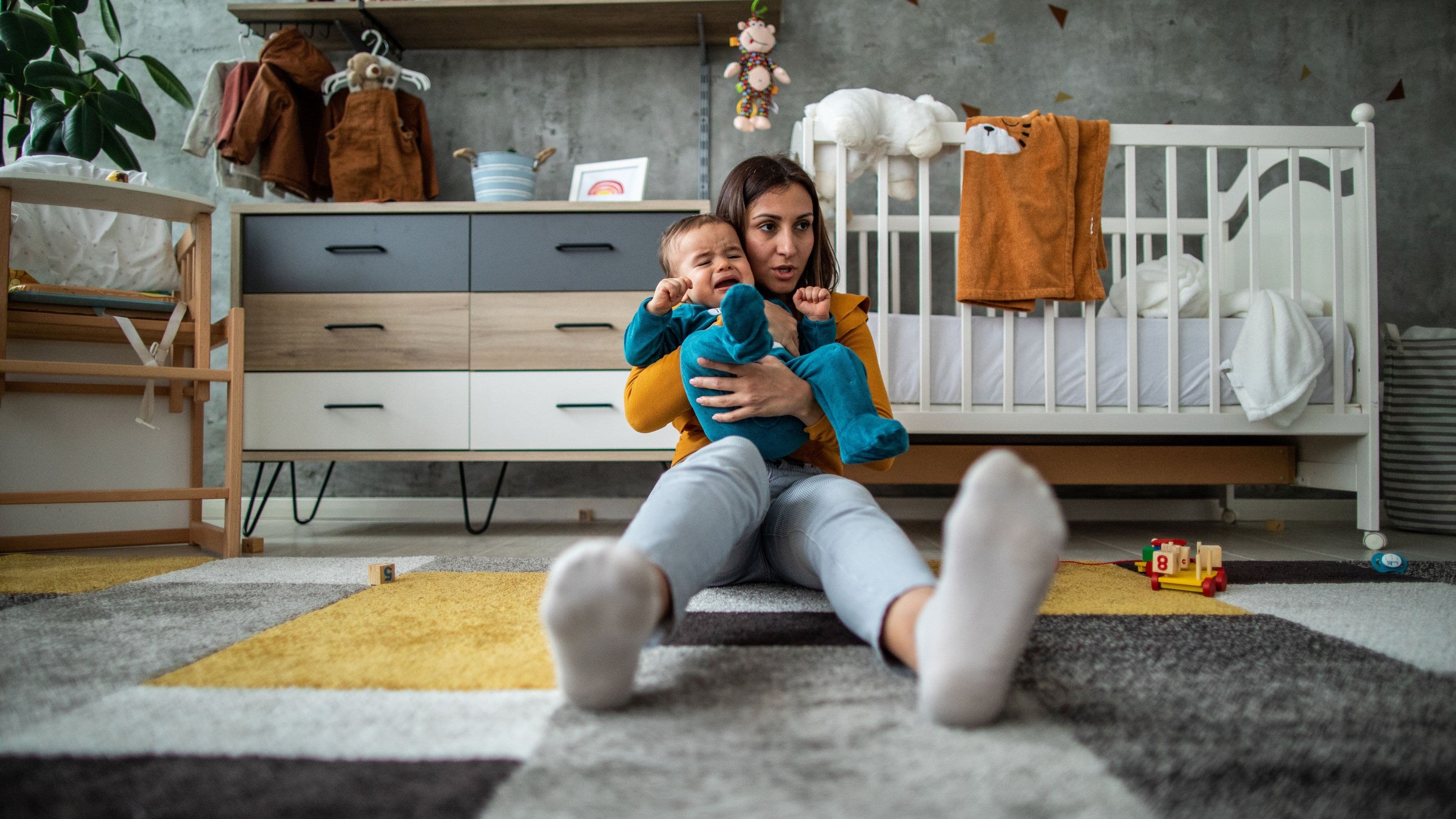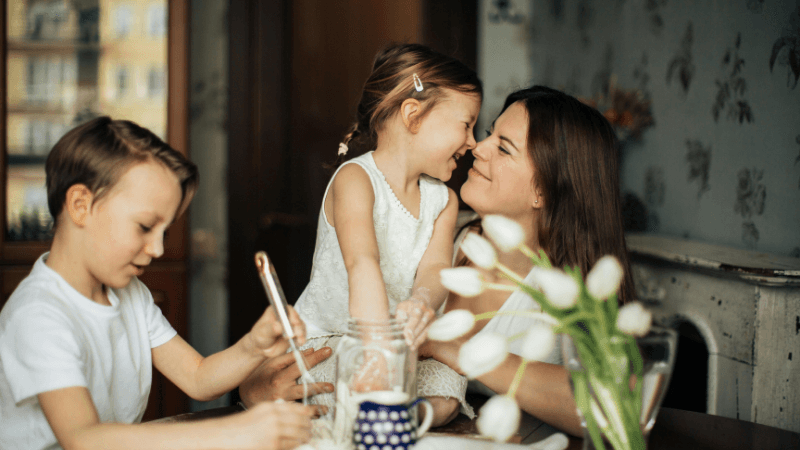
Maya was standing in her kitchen, dinner burning on the stove, her four-year-old in full meltdown on the floor — screaming, kicking, inconsolable over a broken cracker. And Maya, exhausted from a ten-hour workday, felt something ancient and reflexive rise up in her chest: the urge to raise her voice, to say stop it right now, to end the noise by any means necessary. She'd heard that voice in her own childhood. She knew exactly how it landed in a small body.
Instead, she turned off the stove. She sat down on the kitchen floor. She looked her daughter in the eye and said, quietly, "That felt really disappointing, didn't it? I'm right here." The crying didn't stop immediately. But something in the room changed — the air softened, the tension thinned, and within three minutes her daughter had crawled into her lap, hiccupping and calm. Maya sat there afterward, long after the moment had passed, wondering: What was that? Can I do that every time? And does doing it actually matter?
That question — does it actually matter? — is at the heart of every honest conversation about gentle parenting. The internet will tell you it's either the only way to raise emotionally healthy children or a permissive disaster that creates entitled adults with no capacity for frustration. The truth, as it usually does, lives somewhere more nuanced, more human, and considerably more interesting than either extreme.
What Gentle Parenting Actually Is
Before we can ask whether it works, we need to get clear on what we're actually talking about — because "gentle parenting" has become one of those terms that gets stretched to mean almost anything depending on who's using it.
Gentle parenting is a philosophy rooted in four core principles: empathy, respect, understanding, and boundaries. It was most thoroughly articulated by British parenting author Sarah Ockwell-Smith in her 2016 book The Gentle Parenting Book, though its foundations stretch back decades into developmental psychology, attachment theory, and the landmark research of figures like John Bowlby and Diana Baumrind. At its center is a simple but demanding premise: children are whole people with legitimate emotional lives, and parenting them well means responding to those emotional lives with curiosity rather than control.
What gentle parenting is not is equally important to understand. It is not permissive parenting — the "anything goes, no boundaries" approach that critics often conflate it with. It is not about eliminating consequences or allowing children to run the household. It is not a rejection of structure. In fact, gentle parenting is deeply invested in consistent, clear boundaries — the difference is in how those boundaries are communicated and enforced: with warmth and explanation rather than fear and punishment.
1. The Floor Moment Changes Everything
When Maya sat down on that kitchen floor, she was doing something that feels small and looks enormous in practice: she was regulating herself first. This is the unglamorous engine of gentle parenting — not the soft voice or the validating language, but the internal work a parent does in the split second before they respond.
Gentle parenting asks parents to become students of their own nervous systems. It borrows heavily from what neuroscience calls co-regulation — the process by which a calm, regulated adult nervous system literally helps settle a dysregulated child's nervous system. Dr. Daniel Siegel, clinical professor of psychiatry at UCLA and co-author of The Whole-Brain Child, describes this as the brain's capacity for "integration" — connecting the rational, planning parts of the brain with the emotional, reactive parts. When a parent stays grounded during a child's storm, they're not just modeling calm — they're neurologically helping create it.
This is also, notably, the hardest part. Sitting on the floor in a moment of chaos when every instinct screams fix this now requires a kind of inner stillness that isn't natural to most adults — especially those raised in households where emotions were managed through suppression or punishment. The work of gentle parenting, it turns out, begins not with the child at all. It begins with the parent's own healing.
2. Validation Isn't Agreement — It's Connection
One of the most persistent misconceptions about gentle parenting is that validating a child's feelings means endorsing their behavior. When Maya said "that felt really disappointing," she wasn't telling her daughter that melting down over a cracker was reasonable. She was acknowledging that the feeling of disappointment was real — and that real feelings deserve recognition, not dismissal.
This distinction — between validating the emotion and accepting the behavior — is foundational. Research published in the journal Child Development found that children whose parents consistently acknowledged their emotional experiences developed stronger emotional regulation skills, higher empathy, and more resilient responses to stress over time. The children who were told to "stop crying" or "it's not a big deal" didn't learn that feelings were manageable — they learned that feelings were shameful, something to suppress rather than process. That suppression doesn't disappear. It migrates — into anxiety, reactivity, and eventually the same emotional patterns they'll carry into their own adult relationships.
When you say to a child, "I can see you're really frustrated right now," you are handing them a mirror. You're showing them that their inner experience is visible, comprehensible, and survivable. That is not softness. That is some of the most sophisticated emotional education a human being can receive.
3. Boundaries Are the Love Language Nobody Talks About
Here is where gentle parenting gets misunderstood most catastrophically: the assumption that being gentle means being boundless. In reality, gentle parenting is defined by boundaries — it simply insists that those boundaries be explained rather than merely enforced.
The difference sounds like this. Traditional: "Because I said so." Gentle: "You can't hit your brother because hitting hurts people, and we keep our bodies safe in this house." Both versions hold the boundary. Only one of them builds understanding. Over hundreds of these exchanges, the child raised with explained boundaries develops what psychologists call internalized moral reasoning — the capacity to make ethical decisions based on understanding rather than fear of punishment. Fear-based compliance tends to evaporate the moment the authority figure isn't watching. Internalized values don't.
Dr. Becky Kennedy, founder of Good Inside and author of Good Inside: A Guide to Becoming the Parent You Want to Be, frames this powerfully: "The goal isn't a child who complies. It's a child who develops the internal resources to navigate the world." Boundaries, in the gentle parenting framework, aren't walls that keep children in line — they're the scaffolding around which children learn to build their own self-regulation. Hold them warmly, hold them firmly, and explain them every time. The repetition is the point.
4. It Works — With a Crucial Caveat
The research on gentle parenting — or what developmental psychologists more formally call authoritative parenting (warm + structured, as distinct from authoritarian, permissive, or uninvolved) — is among the most replicated findings in developmental psychology. Diana Baumrind's foundational studies, first published in the 1960s and updated repeatedly since, consistently show that children raised with authoritative parenting demonstrate better academic outcomes, stronger social competence, higher self-esteem, and lower rates of anxiety and behavioral problems than children raised under any other parenting style.
A 2021 meta-analysis published in Psychological Bulletin reviewed 1,284 studies across multiple countries and cultures and found that warmth and structure together — the dual pillars of gentle parenting — were the most consistent predictors of positive child development outcomes across nearly every metric studied. This is not fringe research. This is among the most robust evidence in all of developmental psychology.
The caveat — and it matters enormously — is that gentle parenting is not a performance. It cannot be applied as a script while the parent's internal state screams something different. Children are exquisitely sensitive to emotional congruence; they feel the gap between what a parent says and what a parent's body, voice, and energy actually communicate. Gentle parenting practiced with resentment or performed through clenched teeth is not gentle parenting — it's emotional suppression wearing a compassionate costume. The approach only works when it's rooted in genuine presence, and genuine presence requires that parents attend to their own emotional health with the same seriousness they bring to their child's.
5. Your Childhood Lives in Your Parenting
There is a concept in psychology called intergenerational transmission — the well-documented process by which parenting patterns, emotional responses, and attachment styles pass from parent to child to grandchild across generations, often without anyone consciously choosing it. The way your parent responded when you cried is almost certainly influencing how you respond when your child cries, operating below the level of intention and choice.
Gentle parenting, taken seriously, is a practice of intergenerational healing. It asks parents to look honestly at the emotional education they received, to identify where they were dismissed, shamed, frightened, or ignored — and to make a different choice in the present moment, even when every conditioned reflex is pulling toward the familiar. This is not easy work. It is, in the gentlest possible sense, grief work — mourning the emotional attunement you may not have received while choosing to offer it to someone else.
If you find certain emotional situations with your child disproportionately triggering — tears that feel unbearable, anger that feels threatening, clinginess that feels suffocating — those reactions are almost never really about your child. They are echoes. Recognizing them as such, with compassion rather than shame, is both the beginning of inner healing and the beginning of genuinely different parenting. As Rumi wrote, and as every parent sitting on a kitchen floor eventually discovers: "Yesterday I was clever, so I wanted to change the world. Today I am wise, so I am changing myself."
6. Imperfection Is Part of the Practice
One of the quietest and most damaging side effects of the gentle parenting movement's rise on social media is the image of the serene, eternally patient parent — soft voice always, tears always validated, never reactive, never depleted, never just done. That parent does not exist. More importantly, trying to become that parent is its own form of harm.
Gentle parenting is not a standard of perfection to maintain — it is a direction to keep orienting toward. You will yell sometimes. You will lose your patience, say something sharp, shut down a conversation before it deserved to be shut down. The repair that follows — the "I lost my cool earlier and I'm sorry. That wasn't okay. Let's talk about it" — is not a failure of gentle parenting. It is gentle parenting in one of its most potent forms. It models accountability. It shows children that adults make mistakes and take responsibility for them. It demonstrates that relationships can hold rupture and repair, that love doesn't require perfection to be real.
Dr. Dan Siegel calls this "rupture and repair" — and describes it as one of the most powerful tools for building secure attachment between parent and child. The goal was never an unblemished record of perfectly attuned responses. The goal is a child who knows, in their body and their nervous system, that they are safe, seen, and worth showing up for — even on the hard days, even in the messy moments, even when the cracker breaks.
The Quiet Revolution Happening on Kitchen Floors
Gentle parenting is not a trend. It is not an Instagram aesthetic or a parenting personality type. At its truest, it is a form of conscious living extended into the most intimate relationship most people will ever have — the one between a parent and a child who did not ask to be born into this particular family, this particular body, this particular world.
It asks something profound of the people who practice it: not to be endlessly patient, but to be endlessly willing. Willing to sit on the floor. Willing to ask what's underneath the behavior instead of just managing the behavior. Willing to look at the ways they themselves were shaped and choose, in this moment, to shape differently. The research supports it. The child's nervous system responds to it. And for parents who practice it with honesty and compassion — for themselves and their children equally — something else happens too.
They find that in learning to meet their child's emotional experience with presence rather than panic, they are simultaneously learning to meet their own. That the softness they're extending outward begins to turn inward. That the work of gentle parenting has always been, at least in part, the work of gently parenting the self.
Feel that settle in for a moment. The child isn't the only one being raised in this relationship. You are, too.
📚 Sources
Ockwell-Smith, S. (2016). The Gentle Parenting Book. Piatkus
Siegel, D. J., & Bryson, T. P. (2011). The Whole-Brain Child: 12 Revolutionary Strategies to Nurture Your Child's Developing Mind. Delacorte Press.
Kennedy, B. (2022). Good Inside: A Guide to Becoming the Parent You Want to Be. Harper Wave.
Baumrind, D. (1966). "Effects of Authoritative Parental Control on Child Behavior." Child Development, 37(4), 887–907.
Pinquart, M. (2021). "Associations of Parenting Dimensions and Styles with Externalizing Problems of Children and Adolescents: An Updated Meta-Analysis." Developmental Psychology, 57(3), 149–199. Published in Psychological Bulletin.
Morris, A. S., et al. (2017). "The Role of the Family Context in the Development of Emotion Regulation." Social Development, 26(2), 233–261. (Child Development journal reference for emotional validation research.)
Rumi, J. (13th century). As cited and translated widely in Western mindfulness literature, including Barks, C. (1995). The Essential Rumi. HarperOne.