My seven-year-old was mid-meltdown over a sock that felt "weird." My four-year-old had appeared in the kitchen — for the third time — requesting water, a snack, a different blanket, and, inexplicably, to know whether dolphins sleep. My partner and I were communicating entirely in exhausted stares. By the time both kids were finally, mercifully asleep, it was 10:15 p.m., I'd missed my own wind-down window, and I lay in bed wide-eyed and wired, scrolling my phone like a raccoon hunting through trash.
That Tuesday was the night I decided something had to change — not just for the kids, but for all of us.
What followed was several months of experimenting, failing, adjusting, and eventually landing on a bedtime rhythm that transformed our evenings from a nightly hostage negotiation into something that actually felt... peaceful. The key wasn't a rigid schedule or a perfect system. It was a set of small, intentional shifts that signaled to every nervous system in the house — big and little — that the day was done and rest was safe.
Here's what I learned.
1. The Hour Before Bed Is Sacred
The single biggest change we made wasn't at bedtime — it was an hour before it. We started treating the 60 minutes before lights-out as a distinct, protected period we now call the "slow hour." Screens off, voices lower, lighting dimmer. The shift was almost comically immediate: without the stimulation of shows or devices, the kids' bodies started receiving the message that something different was happening.
Melatonin, the hormone that cues sleep, is suppressed by blue light from screens — the National Sleep Foundation notes that exposure to bright light in the evening can delay melatonin release by up to three hours. Three hours. That's not a small footnote; it's the reason your child seems wired at 9 p.m. even when they're clearly exhausted.
Treating this window as sacred doesn't mean silence and strict rules. It means choosing activities that are low-stimulation and sensory-soft — puzzles, quiet drawing, a bath, gentle music. You're not putting kids to bed; you're walking them toward it, step by step.
2. Transition Rituals Are the Real Magic
One evening, I noticed my daughter visibly relax the moment I lit a small candle on the bathroom shelf during her bath. She hadn't asked for it, I hadn't announced it — but her shoulders dropped and she let out a breath like she'd been holding it all day. That's when I understood what transition rituals actually do: they don't just mark time, they communicate safety to the nervous system. The candle said, this part of the day is different. You can let go now.
Transition rituals can be almost anything, as long as they're consistent and sensory. A specific playlist that only plays at bedtime. The ritual of gathering stuffed animals in a certain order. Spraying a lavender mist on pillows. Lighting a dim salt lamp. The content matters far less than the repetition — because repetition is what trains the brain to associate the ritual with the physical sensation of winding down. Dr. Matthew Walker, sleep scientist and author of Why We Sleep, emphasizes that the brain loves predictability around sleep; consistent cues genuinely accelerate the transition into restful states.
3. Baths Are a Biological Cheat Code
This one surprised me when I looked into the science behind it. We'd always done baths somewhat randomly — when the kids seemed grimy, before special occasions, when we had time. Once I learned what a warm bath actually does to the body, we made it a near-nightly anchor. Here's the mechanism: a warm bath raises your core body temperature, and when you step out, that temperature drops rapidly. This drop mimics the natural temperature decline the body undergoes as it prepares for sleep, essentially tricking your physiology into sleep-readiness. A 2019 meta-analysis published in Sleep Medicine Reviews found that bathing in warm water one to two hours before bed improved sleep onset and quality significantly.
For kids, this works even more reliably than for adults. The warm water relaxes tense muscles, the sensory experience of water itself is calming, and the familiar routine of bath-to-pajamas-to-bedroom creates a clear sequence the brain can follow like a map. Make the bathroom atmosphere part of the ritual: dim the lights, use a gentle lavender or chamomile soap, and let them splash without urgency. The bath isn't a task to get through — it's the first act of sleep.
4. The Body Needs to Land Before the Mind Can Rest
After the bath revelation came another one: we'd been skipping the physical settling piece entirely. We'd go from "okay it's bedtime" straight to "lie still and go to sleep" — which, for a child who's been in their body all day, is like asking someone to park a car at full speed. Children, especially those with active temperaments, need help landing in their bodies before they can rest their minds. This is where a few minutes of intentional physical decompression becomes invaluable.
We introduced what we call "heavy body time" — five minutes of deep pressure activities before getting into bed. For my youngest, this looks like firm, slow back presses and what we call the "sandwich" (she lies on the floor while I gently layer pillows on top). For my older one, it's progressive muscle relaxation: I ask him to squeeze each body part as hard as he can, then let go, moving from feet to shoulders. Both kids now ask for these without prompting, which tells me everything about how necessary they were all along. Occupational therapists have long used deep pressure techniques to help regulate the nervous system — the proprioceptive input sends calming signals to the brain that verbal reassurance simply can't replicate.
5. Stories Are the Original Sleep Medicine
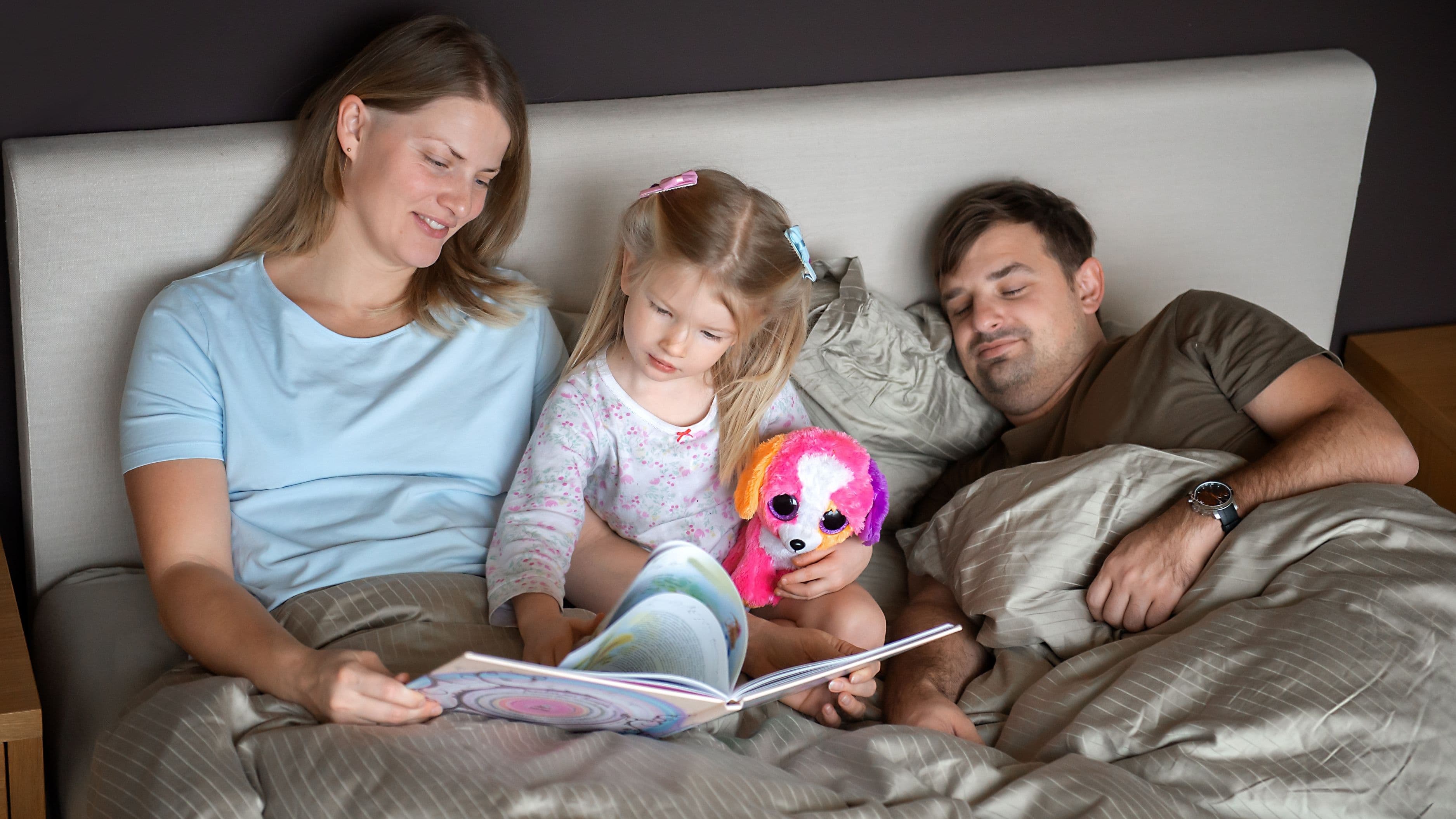
We almost cut story time when evenings got hectic. I'm glad we didn't, because I've come to believe it's one of the most underestimated tools in the family bedtime toolkit — not just for kids, but for the adult reading them. When you tell or read a story, your voice naturally slows. Your breathing deepens. You're no longer mentally composing tomorrow's grocery list — you're present, following a narrative, your own nervous system quieting alongside your child's. It's accidental mindfulness, and it works on everyone in the room.
The type of story matters. High-action plots with conflict and resolution rev the imagination back up; slow, sensory-rich stories that describe peaceful places or gentle adventures are better bedtime medicine. Some families make up "imagination journeys" — collaborative, unscripted stories where the child and parent build a calming scene together: we're walking through a forest, the leaves are soft under our feet, we hear a stream in the distance... This kind of guided imagery is used in sleep therapy for both children and adults, and doing it in story form makes it feel like play rather than practice.
6. The Check-In Question Changes Everything
For months, our bedtime conversation pattern looked like this: "Did you brush your teeth?" "Yes." "Okay, goodnight." Something was missing, and it took an unexpected moment to reveal what. One night my son, lights off, whispered: "Dad, I've been thinking about something all day but there was no time to say it." He then shared something small but clearly significant to him — a worry about a friend, a question about death, something he'd seen at school that confused him. He'd carried it through the entire day waiting for a quiet moment.
That night, we added what we now call the "three things" check-in: one thing that was hard today, one thing that was good, and one thing you're curious or wondering about. It takes five minutes, sometimes less, but it does something profound — it empties the emotional backpack before sleep. Children (and adults) who carry unprocessed thoughts or feelings into bed often experience fragmented sleep, difficulty falling asleep, or nighttime anxiety. Giving those thoughts a place to land — a caring ear, a moment of acknowledgment — is one of the most physiologically and emotionally generous things you can do at the close of a day. Researcher Dr. John Gottman's work on emotional coaching consistently shows that children who feel emotionally heard have better regulation, better sleep, and stronger resilience overall.
7. Parents Need a Landing Spot Too
Here's the part of the conversation most family sleep advice skips entirely: you. Your bedtime matters. Your wind-down matters. A parent who makes it to 10 p.m. fully activated, stress-loaded, and screen-saturated is not modeling rest — and children are extraordinarily perceptive readers of the nervous systems around them. If you're tense, hurried, or mentally elsewhere during the bedtime routine, that energy transmits. Kids don't always have the vocabulary for it, but their bodies register it, and it makes settling harder for everyone.
This isn't a guilt trip — it's an invitation. What would it look like to build just 20 minutes of intentional wind-down into your own evening? Not Netflix, not doomscrolling, but something that genuinely returns you to yourself: a cup of tea without your phone, a few pages of a real book, five minutes of stillness on the couch. When you come to the bedtime routine from a calmer baseline, the whole ritual shifts. You're not rushing them to sleep so you can finally exhale. You're exhaling together, and the difference is felt by everyone.
8. Consistency Beats Perfection Every Time
I'll be honest: we don't execute this routine perfectly. Some nights someone's crying before 7 p.m., someone else forgot a school project, and the slow hour gets hijacked by chaos. The sock meltdowns still happen. But here's what I've noticed: even an imperfect version of a familiar rhythm works better than a perfect version of something new. The brain doesn't need flawless execution — it needs recognizable patterns. If six out of seven nights have the same basic shape, the seventh night catches the draft of the others.
Give yourself at least three to four weeks before you evaluate whether a new routine "works." Sleep habits, especially in children, take time to consolidate. Keep the anchors consistent — the bath, the story, the check-in, the lights — and let the details flex. Routines that are rigid tend to shatter under the pressure of real family life. Routines that have a clear structure but room to breathe? Those are the ones that survive Tuesday nights.
The Moral of All This
Sleep isn't just rest. It's repair, processing, emotional integration, and growth — for children and adults alike. A calming bedtime routine isn't a parenting hack or a productivity optimization. It's an act of care. It says: this day had value, and now it's done, and we are safe, and we can let go. That message — delivered through warm water and soft light and a story and a question asked in the dark — is one of the most important things a family can give itself.
You don't have to build it all at once. Pick one thing from this list and start tonight. Let it become familiar. Then add another. Small, consistent acts of intention have a way of compounding into something that feels, after a while, like peace.
📚 Sources
National Sleep Foundation. (2022). Blue light and sleep. sleepfoundation.org
Haghayegh, S., Khoshnevis, S., Smolensky, M. H., Diller, K. R., & Castriotta, R. J. (2019). Before-bedtime passive body heating by warm shower or bath to improve sleep: A systematic review and meta-analysis. Sleep Medicine Reviews, 46, 124–135. https://doi.org/10.1016/j.smrv.2019.04.008
Walker, M. (2017). Why we sleep: Unlocking the power of sleep and dreams. Scribner.
Gottman, J., & DeClaire, J. (1997). Raising an emotionally intelligent child. Simon & Schuster.
Mindell, J. A., & Williamson, A. A. (2018). Benefits of a bedtime routine in young children: Sleep, development, and beyond. Sleep Medicine Reviews, 40, 93–108. https://doi.org/10.1016/j.smrv.2017.10.007