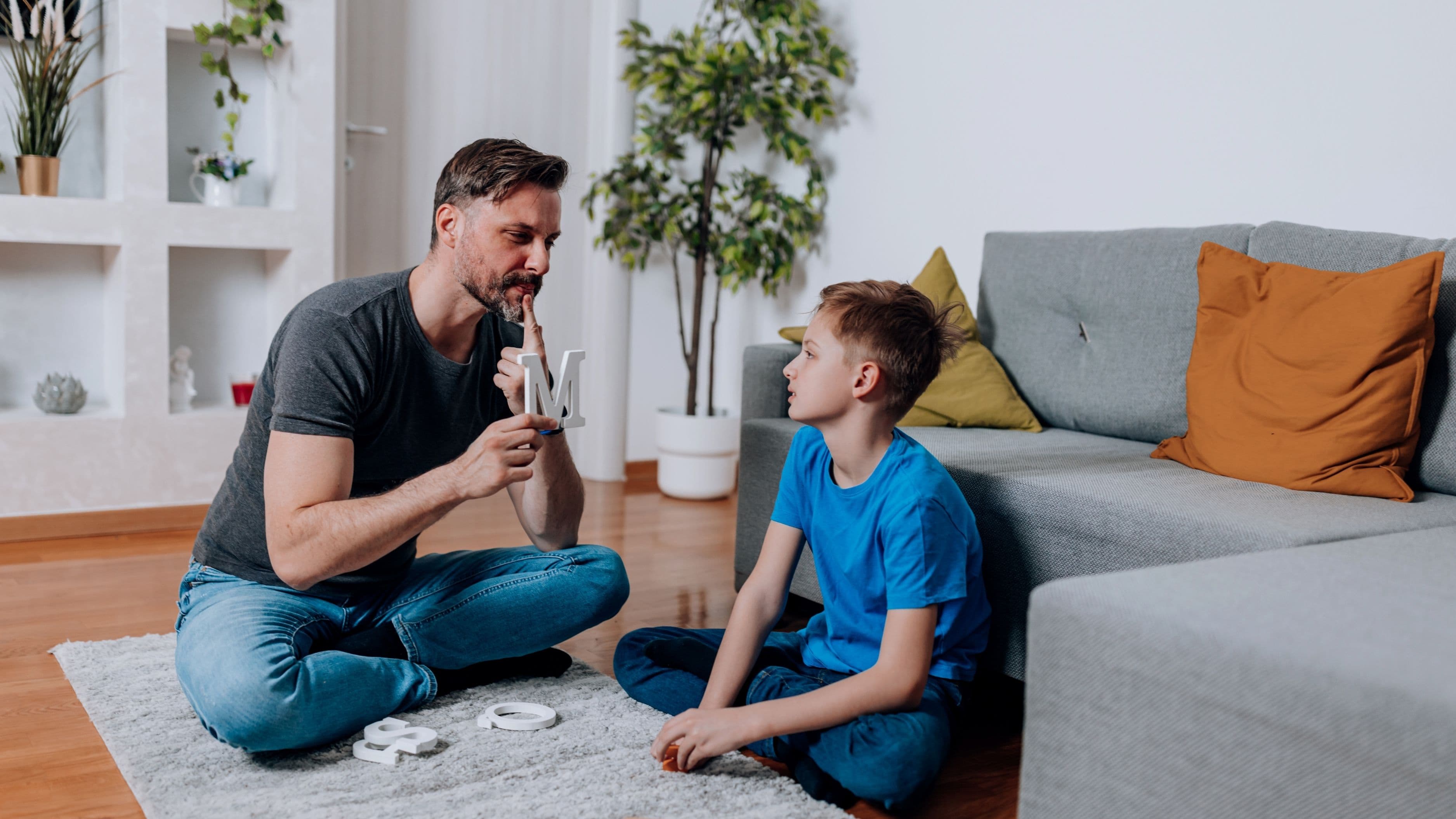
What followed wasn't a breakthrough that night. It was a slow, humbling education over the months that came after — one that required me to unlearn almost everything I thought I knew about talking to my kid and start learning how to be present with him. What I discovered is that the stubborn teenager isn't the problem. Most of the time, the communication approach is.
1. "Stubborn" is usually a translation problem
The word stubborn is doing a lot of work that it shouldn't be. When we label a teenager as stubborn, we're often describing a kid who has stopped trusting that their voice will be received without consequence — so they stop offering it. What looks like a wall is frequently a withdrawal, and withdrawal is almost always a response to something that happened in the relationship dynamic long before the current standoff.
Adolescent psychologist Dr. Dan Siegel, in his book Brainstorm: The Power and Purpose of the Teenage Brain, explains that the teenage brain is undergoing the most dramatic structural renovation since infancy. The prefrontal cortex — responsible for impulse regulation, long-term thinking, and nuanced communication — isn't fully developed until the mid-twenties. This means your teenager isn't being difficult to spite you; they're genuinely operating with a brain that processes emotional threats more intensely and rewards more immediately than yours does. Once you internalize that, the frustration softens into something more useful: curiosity.
2. Timing is everything — and almost always wrong
Most communication attempts with teenagers happen at the worst possible moment: the second they walk through the door, during dinner when they'd rather be anywhere else, or right before bed when the day has already accumulated into a weight they don't have words for yet. These moments feel natural to us as parents because we're ready to connect. But connection requires two people who are both available, and teenagers have very specific windows of availability that adults often miss entirely.
Many parents report that their best conversations with teenagers happen in the car, side by side, eyes forward, going somewhere. There's something about the absence of direct eye contact — that pressure-free, parallel presence — that loosens the jaw of even the most closed-off kid. Late nights also carry a kind of magic: the emotional guard tends to drop when the day is technically over and the lights are low. Pay attention to when your teenager is naturally more talkative, even if it's about something completely unrelated to what you want to discuss. That's your window. Walk through it without an agenda, and see what happens.
3. Questions that corner, close doors
"Did you do your homework?" "Why would you do that?" "What were you thinking?" These questions have something in common beyond the obvious: they're all prosecutorial. They're not invitations to conversation — they're invitations to defend. And a teenager who feels they're being interrogated will do exactly what any reasonable person would do under cross-examination: say as little as possible and wait for it to be over.
The shift from interrogation to genuine curiosity is subtle but seismic. "What was the most annoying part of your day?" lands differently than "How was school?" It signals that you're not looking for a report card — you're interested in their actual experience. "What do you think about that?" instead of "Here's what you should do" creates space for them to reason out loud rather than shut down. Open-ended questions that assume something interesting happened — rather than questions that assume a right answer — transform the entire tenor of a conversation before it's even begun.
4. Being heard beats being right, every time
Here is the painful truth most parents learn late: when a teenager is in emotional distress — angry, embarrassed, overwhelmed — the last thing their nervous system can process is a logical argument, a correction, or a lesson. The brain in high-emotion mode is not available for rational input. It's flooded. And flooding a flooded brain with more information doesn't help; it just raises the water level.
What does work is acknowledgment — plain, simple, and without conditions attached. "That sounds really frustrating" before any advice. "I can see why you'd feel that way" before any correction. It doesn't mean you agree. It means you're willing to stand in their experience for a moment before pulling them toward yours. Research from the Gottman Institute consistently shows that emotional validation — particularly from parents — is one of the strongest predictors of adolescent willingness to disclose and communicate openly. You don't have to abandon your values or your household rules to make your teenager feel heard. But you do have to choose, in that charged moment, between being right and being connected.
5. Your nervous system sets the temperature
Walk into a conversation with a teenager while you're already clenched with frustration and watch what happens. Their nervous system reads yours before a word has been exchanged — teenagers are exquisitely sensitive to the emotional undercurrent in a room, even when (especially when) they appear completely indifferent to it. The crossed arms, the flat tone, the strategic headphones — much of this is a direct mirror of the emotional climate they've learned to expect.
This is where your own mindfulness practice becomes not just personally useful but relationally essential. Before a difficult conversation, take three slow breaths. Feel your feet on the floor. Soften the muscles around your eyes, your jaw, your shoulders. Not as a performance of calm, but as a genuine recalibration — bringing your nervous system to a settled place so that yours becomes an environment they can actually enter. A regulated parent is, quite literally, a neurological invitation to a dysregulated teenager. You go first. You always go first.
6. Repair is the real relationship
Every relationship between a parent and teenager has ruptures. Moments when you said too much, reacted before you thought, brought your own unprocessed frustration into a conversation that deserved better. The ruptures aren't the failure — they're inevitable. What matters, deeply and measurably, is whether repair follows.
Going back to your teenager and saying, "I handled that badly the other night, and I'm sorry" is not a loss of authority. It is a demonstration of the exact emotional intelligence you're trying to model. It shows them that relationships can survive conflict, that adults can be accountable, and that the connection between you is strong enough to hold the honest truth. Dr. John Gottman's research on family dynamics found that the repair attempt — not the absence of conflict — is the single most important predictor of long-term relationship health. Your teenager is watching how you handle being wrong. Make it something worth seeing.
The Conversation That's Always Happening
Long after that Tuesday evening with the pasta and the headphones and the suffocating quiet, my son and I found our rhythm. It didn't happen because I found the perfect thing to say. It happened because I stopped trying to say the right thing and started trying to be the right presence — steady, curious, unhurried, and willing to sit in the silence without needing to fill it.
The stubborn teenager across from you is not your opponent. They are a person in the middle of one of the most destabilizing developmental periods of human life, trying to figure out who they are while still needing you more than they'll ever say out loud. Your job isn't to break through their walls. It's to make yourself someone they eventually choose to let in. Keep showing up — imperfectly, honestly, and with your heart genuinely open. The conversation you've been waiting for is already on its way.
📚 Sources
Siegel, D. J. (2013). Brainstorm: The Power and Purpose of the Teenage Brain. Tarcher/Penguin.
Gottman, J. M., & DeClaire, J. (1997). Raising an Emotionally Intelligent Child. Simon & Schuster.
Gottman, J. M., & Silver, N. (1999). The Seven Principles for Making Marriage Work. Crown Publishers. (Repair attempt research applicable to family dynamics.)
Steinberg, L. (2014). Age of Opportunity: Lessons from the New Science of Adolescence. Houghton Mifflin Harcourt.