The good news is that understanding and improving the air in your home doesn't require a renovation or an expensive HVAC overhaul. A handful of thoughtful devices can give you a clear picture of what's actually in the air around you, and help you do something about it. This guide walks through the key categories of devices, what to look for, and which ones are genuinely worth bringing into your space.
Why Indoor Air Quality Deserves Your Attention
Before reaching for any device, it helps to understand what indoor air quality actually means – and why it's easy to overlook. Unlike outdoor air pollution, which is visible and talked about, indoor air issues are invisible. You can't smell low-level carbon dioxide buildup, you can't see fine particulate matter, and you won't necessarily notice elevated humidity until mold has already started forming somewhere in your walls.
The EPA has noted that indoor air can be two to five times more polluted than outdoor air in some cases, largely because modern homes are built to be airtight and energy-efficient, which reduces natural ventilation. Cooking, candles, cleaning products, off-gassing from furniture, and even the act of breathing all contribute to the air in your home shifting over the course of a day. Poor indoor air quality has been linked to headaches, fatigue, disrupted sleep, and respiratory irritation – symptoms that are easy to blame on stress or screen time, but that sometimes have a simpler environmental explanation.
Getting a sense of what's in your air – and making a few targeted adjustments – can make a genuinely noticeable difference in how your home feels to live in.
Air Quality Monitors: Know What You're Breathing
The most useful first step you can take is simply measuring the air in your home. An air quality monitor sits on a surface, continuously reads the air around it, and shows you data on a display or an app. Without one, any improvements you make are essentially guesswork.
What to Look For in an Air Quality Monitor
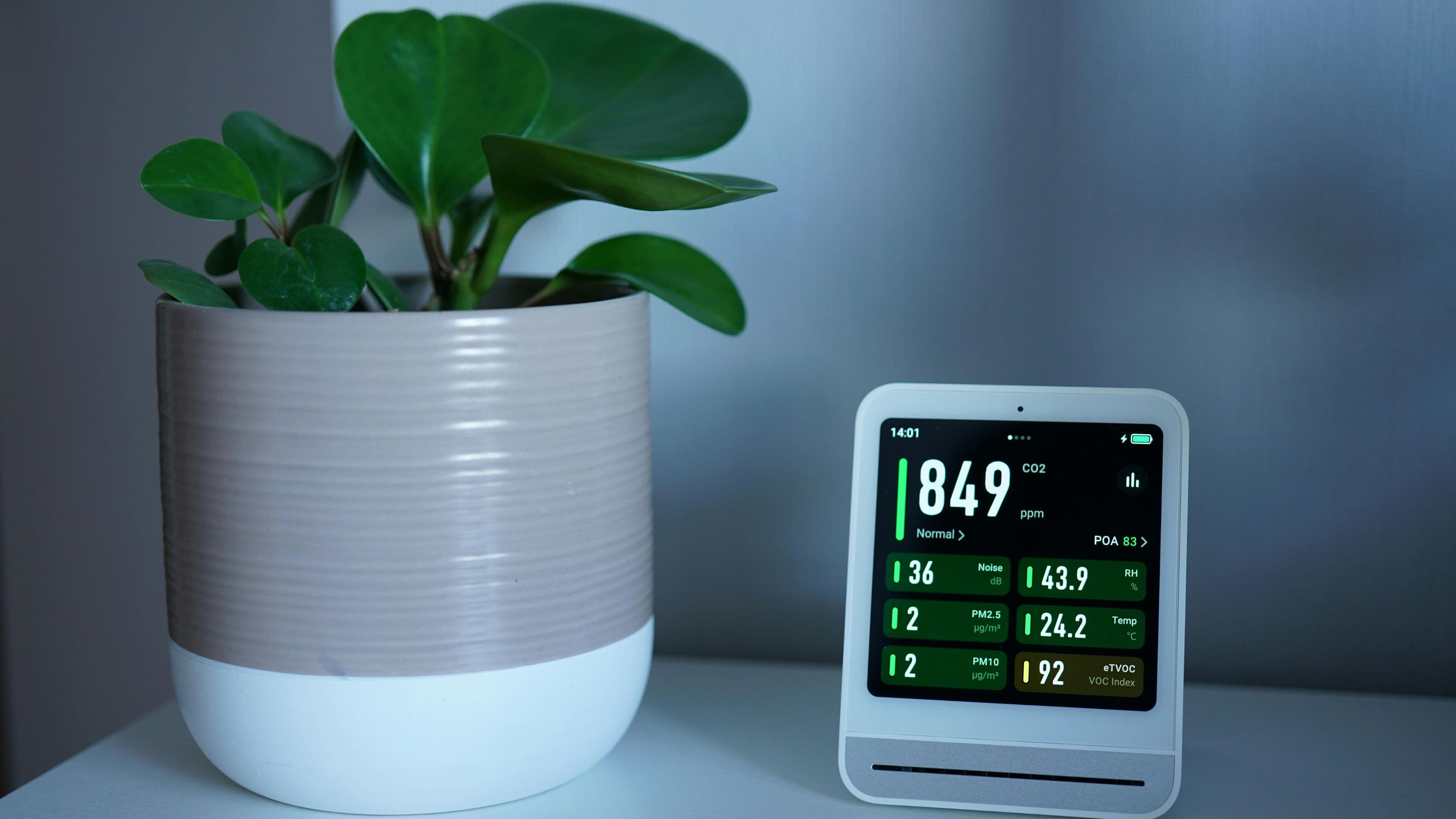
A good home air quality monitor should track at minimum: PM2.5 (fine particulate matter, the kind that gets deep into your lungs), CO2 (carbon dioxide levels, which are a reliable indicator of ventilation quality), VOCs (volatile organic compounds from cleaning products, furniture, and paints), temperature, and humidity. Some also track PM10 (larger particles), formaldehyde, and radon.
The display matters too. A device that buries its readings in a hard-to-navigate app won't actually change your behavior. Look for a monitor with a clear, readable display that gives you at-a-glance information without requiring you to pull out your phone every time.
Recommended Monitors
The Airthings View Plus is one of the most comprehensive consumer air quality monitors available. It tracks PM2.5, CO2, VOCs, humidity, temperature, air pressure, and radon – all in a single device with a clear color-coded display and a companion app that shows trends over time. The radon monitoring in particular sets it apart from most competitors, since radon is a naturally occurring radioactive gas that is the second leading cause of lung cancer in the US and is invisible and odorless. For anyone living in a ground-floor apartment or a house with a basement, radon awareness is genuinely important, not just a nice-to-have.
The Awair Element is a more streamlined option that focuses on the five factors most commonly linked to comfort and health: CO2, VOCs, humidity, temperature, and PM2.5. Its app is particularly well-designed, with a daily score and practical recommendations based on your readings – "open a window," "your CO2 is high, take a break outside" – that make the data actionable rather than just informational. It's a good choice if you want something that tells you what to do, not just what it measured.
For a more budget-conscious entry point, the Temtop M2000 offers solid PM2.5, CO2, temperature, and humidity tracking with a clean display at roughly half the price of the premium options. It's a good starting monitor if you want to understand your baseline air quality before investing in more advanced devices.
Air Purifiers: Remove What's Already There
Once you have a sense of what's in your air, a purifier helps you do something about it. Air purifiers pull room air through a series of filters, trap particles and pollutants, and circulate cleaner air back into the space. They won't solve every air quality issue – a purifier can't reduce CO2 the way ventilation can, for example – but for particulate matter, allergens, pet dander, smoke, and certain VOCs, a good purifier makes a real difference.
What to Look For in an Air Purifier
The most important factor is filtration. A true HEPA filter captures 99.97 percent of particles 0.3 microns or larger – which covers dust, pollen, mold spores, pet dander, and most smoke particles. Some purifiers also include an activated carbon layer, which helps absorb VOCs and odors. For most homes, a true HEPA filter combined with activated carbon is the combination worth prioritizing.
Coverage area matters significantly. A purifier rated for 300 square feet will struggle in a 600 square foot open-plan space. Look at the CADR (Clean Air Delivery Rate) – a standardized measure of how much clean air the unit produces per minute – and match it honestly to the room you're placing it in. Underpowering a purifier is one of the most common mistakes people make when choosing one.
Noise is worth thinking about if you're placing a purifier in a bedroom. Most quality units have a sleep mode that runs quieter, but the difference between models can be significant, and a purifier you turn off at night because it's too loud is providing no benefit.
Recommended Purifiers
The Coway Airmega AP-1512HH (often called the Mighty) is consistently one of the highest-rated purifiers for the price. It covers up to 360 square feet, uses a four-stage filtration system including true HEPA and activated carbon, runs quietly on its lower settings, and has an air quality indicator that adjusts fan speed automatically. It's the kind of device you set up once, forget about, and feel the benefit of without thinking much about it.
The Levoit Core 300 is a smaller option well-suited to bedrooms and home offices – spaces up to about 220 square feet. It's compact, runs very quietly on its sleep mode, and uses a three-in-one filter (pre-filter, HEPA, and activated carbon) that's easy to replace. For anyone wanting a purifier specifically for the room they sleep in, this is one of the most thoughtful choices in its price range.
For larger spaces or open-plan living areas, the Blueair Blue Pure 411i Max offers strong CADR for its size and uses a washable pre-filter paired with a HEPA-carbon layer. It's one of the better-looking units available if aesthetics matter to you, and its simple one-button operation keeps the experience uncomplicated.
Smart Ventilation and Humidity Control
Two factors that air purifiers can't fully address are CO2 and humidity – and both have a significant impact on how a space feels and how well you sleep and think in it.
CO2 and Ventilation
CO2 accumulates in closed spaces faster than most people expect, especially in bedrooms overnight. A CO2 reading above 1,000 ppm (parts per million) is associated with reduced cognitive function – foggy thinking, difficulty concentrating, mild headaches. Above 2,000 ppm, the effects become more pronounced. Outdoor air is typically around 400–420 ppm. The solution is simple: ventilation. Opening windows regularly, even briefly, exchanges stale indoor air with fresh outdoor air and brings CO2 levels back down.
Some newer homes and apartments include smart ventilation systems or heat recovery ventilators (HRVs) that bring in fresh air without significant heat loss. If your home doesn't have one and you notice consistently high CO2 readings on your monitor, it's worth looking into whether a simple mechanical ventilator or air exchanger makes sense for your space. For most people, though, a habit of opening windows for 10–15 minutes a day in different rooms is enough to make a meaningful difference.
Humidity Control
Indoor humidity ideally stays between 40 and 60 percent. Below 30 percent, air becomes dry enough to irritate your respiratory system, cause static electricity, and dry out skin and sinuses. Above 60 percent, the risk of mold growth and dust mite populations increases significantly. Both extremes affect sleep quality and comfort in ways that are easy to feel but hard to pinpoint without measuring.
A smart humidifier like the Levoit Classic 300S adds moisture to dry air during winter months when heating systems strip humidity from indoor spaces. It connects to an app, can be set to maintain a target humidity level automatically, and runs quietly enough for bedroom use. If you live in a dry climate or heat your home heavily in winter, a humidifier in your bedroom is one of the most straightforwardly impactful wellness upgrades you can make.
For homes or climates where humidity runs high rather than low, a dehumidifier like the hOmeLabs 35 Pint Dehumidifier is worth considering. It runs continuously in spaces with persistent moisture problems – basements, bathrooms, humid summer climates – and reduces the conditions that support mold growth. Pairing one with an air quality monitor that tracks humidity gives you a feedback loop: you can see exactly when the dehumidifier is needed and confirm it's working.
A Few Things to Avoid
One of the most common mistakes when approaching indoor air quality is buying an air purifier with an ionizer or ozone generator without understanding the trade-offs. Ozone-generating air purifiers are marketed as powerful purifiers, but ozone is itself a lung irritant – the EPA has noted that ozone can worsen asthma and other respiratory conditions at the levels some of these devices produce. Stick to true HEPA filtration and avoid any device that advertises ozone generation as a feature.
It's also easy to over-rely on a single device. A purifier alone won't fix a ventilation problem, and a humidifier alone won't help if the air is also full of particulates. Thinking about indoor air quality as a system – monitoring, filtering, ventilating, and controlling humidity – gives you a more complete and effective approach than any one device can provide.
Finally, don't neglect the basics. Air quality devices work best alongside simple habits: replacing HVAC filters on schedule, vacuuming with a HEPA-filtered vacuum, reducing VOC sources like synthetic air fresheners and harsh cleaning products, and keeping moisture-prone areas like bathrooms well-ventilated. Devices amplify good habits; they're less effective as a substitute for them.
Building a Simple Air Quality Setup
If you're starting from scratch, a practical sequence is to begin with a monitor. Spend a week or two observing your readings at different times of day – during cooking, overnight in the bedroom, during the day in your workspace. This gives you a real picture of where your air quality issues actually are before you spend anything on solutions.
From there, a bedroom purifier is usually the highest-impact next step, since better sleep quality often has cascading effects on how you feel during the day. Add humidity control if your readings suggest it's needed, and revisit ventilation habits if CO2 consistently runs high.
You don't need to overhaul your entire home at once. Small, intentional changes, made thoughtfully, tend to stick. And once you can see the data in your air quality monitor responding to the choices you make, the whole thing becomes genuinely satisfying – a quiet, ongoing practice of caring for the environment you live in.
FAQ
How do I know if I actually have an air quality problem at home?
The most reliable way is to measure. Many people are surprised by what a monitor reveals – CO2 that climbs significantly during sleep, humidity spikes during cooking, or VOC readings that increase after using certain cleaning products. Symptoms like persistent fatigue, morning headaches, or nasal irritation at home can also be signals worth investigating.
Do air purifiers really make a noticeable difference?
For people with allergies, asthma, or sensitivity to dust and pet dander, the difference is often significant. For others, the improvement is more subtle – a room that simply feels fresher and easier to breathe in. The impact is greatest in bedrooms and spaces where you spend the most consecutive hours.
Where should I place an air purifier for best results?
In the room where you spend the most time – usually the bedroom. Place it a few feet off the floor with clearance on all sides so it can draw air freely. Avoid tucking it into corners or behind furniture, which significantly reduces its effectiveness.
How often do filters need to be replaced?
Most HEPA filters need replacing every 6–12 months depending on use and air quality. Many purifiers have a filter-change indicator that takes the guesswork out of it. Running a purifier with a clogged filter is ineffective and can strain the motor, so this is one maintenance step worth staying on top of.
Are expensive air quality monitors worth it over cheap ones?
Generally, yes – with a caveat. Budget monitors can be inconsistent in their sensor accuracy, particularly for VOCs, where cheap sensors tend to be imprecise. For CO2 and PM2.5, mid-range monitors perform well. If radon is a concern for your home type or region, that specific measurement requires a dedicated or premium monitor.
The air in your home is something you interact with every single moment you're there, breathing it in during sleep, during meals, during rest. Giving it a little attention – measuring it, filtering it, managing it gently – is one of the quieter, more foundational things you can do to support your wellbeing. Not dramatic, not expensive, just deliberate. And that's enough.
📚 Sources
EPA – Indoor Air Quality overview – https://www.epa.gov/indoor-air-quality-iaq
EPA – Ozone generators sold as air cleaners – https://www.epa.gov/indoor-air-quality-iaq/ozone-generators-sold-air-cleaners
EPA – Introduction to Indoor Air Quality – https://www.epa.gov/indoor-air-quality-iaq/introduction-indoor-air-quality
EPA – Radon: the health risk with a simple solution – https://www.epa.gov/radon/radon-health-risk
NIH – Indoor CO2 levels and cognitive performance – https://www.ncbi.nlm.nih.gov/pmc/articles/PMC3548274/
ASHRAE – Humidity and thermal comfort standards – https://www.ashrae.org/technical-resources/bookstore/thermal-comfort
EPA – Volatile Organic Compounds' impact on indoor air quality – https://www.epa.gov/indoor-air-quality-iaq/volatile-organic-compounds-impact-indoor-air-quality